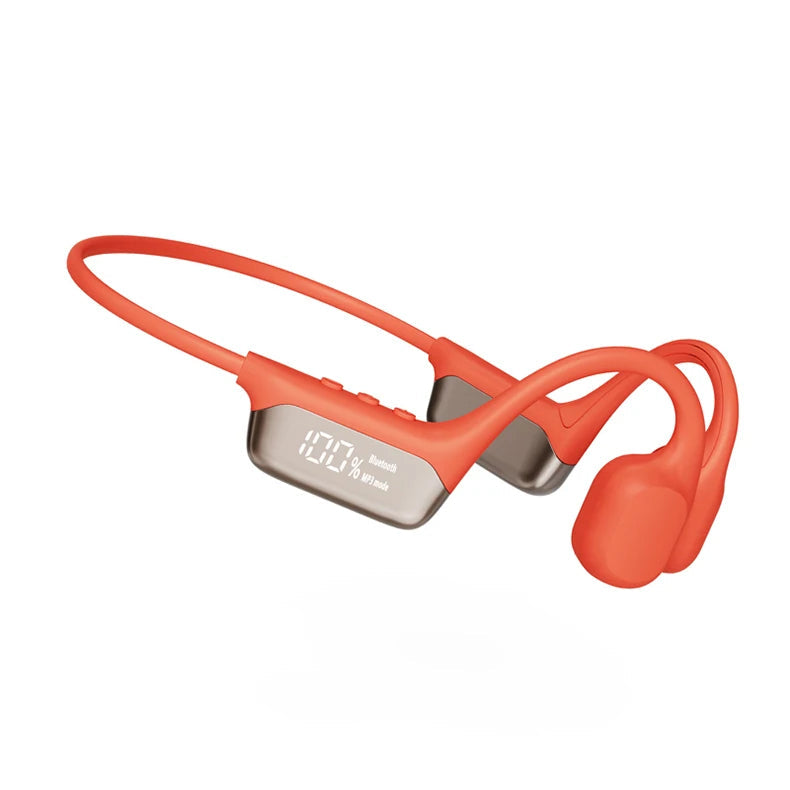
Waterproof Bone Conduction Swimming Earphones – Bluetooth 5.4 MP3 Headset (32GB)
Waterproof Bone Conduction Swimming Earphones – Bluetooth 5.4 MP3 Headset (32GB)
Couldn't load pickup availability
Your music does not stop when your head goes under
Every pair of waterproof earbuds sold for swimming does the same thing. They play beautifully on the pool deck, then cut out the instant you push off. That is not a fault in the earbuds — water stops a Bluetooth signal within inches, so there is simply nothing left for them to receive.
This headset does not depend on a signal at all. Your music sits on the device itself, thirty-two gigabytes of it, and keeps playing lap after lap while your phone stays locked in a locker on the other side of the building.

The 32 GB is the whole product, not a bonus feature
Connect the headset to a computer with its magnetic cable and drag files across, the same as you would to a USB stick. It reads MP3, WAV, WMA and APE. Switch it into MP3 mode on the pool deck and it plays from its own memory with nothing else involved — no pairing, no phone, nothing to drop out. Two demonstration tracks are already loaded, so you can hear it working before you copy anything at all.

Sound through your cheekbone, ears left open
Two flat pads rest on the cheekbone just in front of the ear and pass vibration through bone to the inner ear. Nothing goes into the ear canal — which matters more in water than anywhere else, because a sealed tip traps water against your eardrum and works itself loose on every push-off. It also leaves your ears free to do their job: you still hear the lifeguard, your coach, and the swimmer about to overtake you. Most people find it sounds fuller once they are under, because water carries the vibration better than air does.

It stays where you put it
The band is one continuous piece that holds tension behind the head, and the hooks sit over the tops of your ears rather than inside them, so a turn does not shift it. It is made to be worn with a cap and goggles: pull the cap down over the band and it is effectively locked on, which is what most regular swimmers end up doing. At 1.3 oz you stop noticing it a length or two in.

One headset for the swim and for the walk home
Out of the water, Bluetooth 5.4 connects it to your phone in a couple of seconds — podcasts on the way home, calls at the gym through the built-in microphone, a run the next morning. Open ears are an advantage on land too, at a junction or on a shared path. Around eight hours of playback covers a week of swims for most people, and it charges back to full in about an hour.

What you get
- 32 GB of onboard storage — your music plays with no phone anywhere near you
- Bluetooth 5.4 with a built-in microphone, for use on dry land
- IPX8 rated — rated by the manufacturer for 6.5 ft (2 m) for up to an hour
- Open-ear bone conduction — nothing enters the ear canal
- A small display showing charge level and which mode you are in
- About 8 hours of play; roughly an hour to charge on the magnetic cable
- Plays MP3, WAV, WMA and APE files
- 1.3 oz (37 g)
- Black, white, red or orange-and-navy
Before your first swim
Five minutes once, and the rest is just swimming.
- Charge it and copy your files. Connect the magnetic cable to a computer and drag your tracks across.
- Switch to MP3 mode on the deck. Do this before you get in rather than after. This one step is the difference between a good session and a silent one.
- Set your volume dry. It is far easier to find the level you want standing on the tiles than treading water.
- Rinse it afterwards. Fresh water after chlorine or salt, then dry it before charging. Chlorine and salt are what wear seals and contacts down over time.

What to expect
Bone conduction gives you clear mids and vocals with lighter bass than a sealed earbud. That is the trade for leaving your ears open, and it is the same for every headset built this way. In a pool it is more than loud enough; on a loud street or a train, ambient noise competes with it, because nothing is blocking your ears. Copying files over the cable is slow going, so budget a few minutes for an album rather than expecting a whole library in one sitting. And tracks from a streaming subscription cannot be transferred — MP3 mode plays files you own.
Frequently asked questions
Can I stream from my phone while I am swimming?
No — and neither can anything else on the market. Water blocks the Bluetooth signal. Copy your tracks to the 32 GB onboard storage and play them in MP3 mode. That is exactly why the storage is there.
How do I get music onto it?
Connect it to a computer with the magnetic cable and copy files across, the same as a USB drive. It plays MP3, WAV, WMA and APE. Note that DRM-protected files from a streaming subscription cannot be transferred this way — you need files you own.
How deep can I take it?
It carries an IPX8 rating, which the manufacturer specifies as 6.5 ft (2 m) for up to an hour. That covers pool swimming, laps, showers and open water at the surface. It is not a diving device.
Will it stay on for a proper set?
Yes, with the band adjusted snugly against the back of your head. For dives, turns and anything vigorous, wearing it under a swim cap is the reliable approach.
Does it work with goggles and a cap?
Yes. The band sits behind the head below the goggle strap, and the cap goes over the top of both.
Is it loud enough?
In the water, comfortably — and most people find it sounds fuller under the surface than above it. On land it is plenty in ordinary surroundings, but in genuinely loud places your open ears will hear the traffic as well as the music.
Can I take calls on it?
On dry land, over Bluetooth, yes — there is a microphone built in. Not in the water, for the same reason music will not stream there.
How long does a charge last?
About eight hours of play, and roughly an hour to charge back to full. The display tells you where you are before you get in, which saves discovering it at the far end of the pool.
Do I need to do anything after a swim?
Rinse it in fresh water after pool or sea use and dry it before charging.