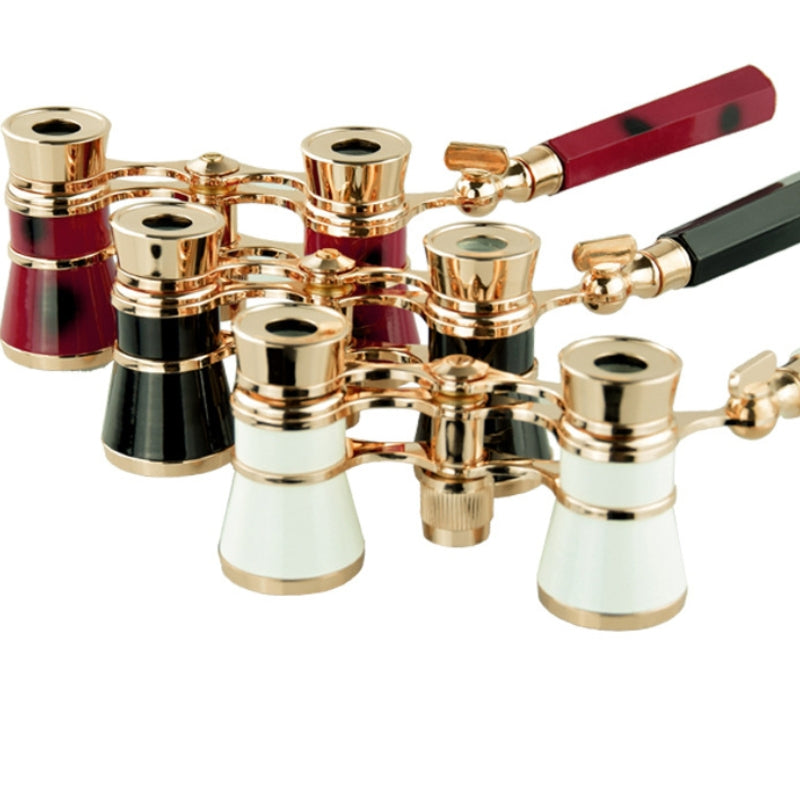
Vintage Opera Glasses — Compact Theater & Racecourse Binoculars, With or Without Handle
Vintage Opera Glasses — Compact Theater & Racecourse Binoculars, With or Without Handle
Couldn't load pickup availability
Small enough to live in a clutch. Worth taking out when you get there.
These are opera glasses in the old sense: a little pair of gold-toned binoculars on an ornate pierced frame, made to be carried to a theatre, a concert or a race meeting and then actually used. They measure about the width of a phone across the front and sit in one palm. Nothing about them announces itself until you lift them.
The reason people buy this style rather than a pocket binocular is the handle. It holds the glasses out at your eyes with one hand, so you are not clamping a pair of binoculars to your face with both arms up for the length of an act. You can hold a programme, or a glass, in the other hand.
And when the handle is in the way, it folds back against the body — or comes off entirely with one small screw.

The handle screws on, folds flat, and lifts off
This is the part most listings get wrong, so here is exactly what it does. The handle is a slim faceted rod with a turned gold collar at one end. It fixes to a small hinged lug on the right-hand side of the frame, held there by a single small screw that ships with it.
Once it is on, it pivots. Swing it down and it becomes a grip. Swing it back and it lies flat along the barrels, which is how the whole thing goes into a bag. Undo the screw and the handle comes away completely, leaving a plain pair of opera glasses.
It does not telescope and it does not retract into itself. Some listings for this style say "retractable". It is not — it is detachable and it folds. We would rather you knew that before it arrives than after.

One wheel in the middle, and that is the only control
Between the two barrels there is a single knurled wheel. Turn it and both barrels move together until the stage comes sharp. That is the whole interface — there is nothing else to set, no dioptre rings to balance, no caps to lose.
It is a simple mechanism and it is the right one for a dark auditorium, where you want to find focus by feel in about a second and then forget about it.

What to expect when you look through them
We are not going to print a magnification figure for these. This style is widely listed as "3x25". We went looking for something to stand that figure on — a maker's specification, an optical datasheet, a marking on the body itself — and we could not find one. The only measured drawing the manufacturer publishes gives the outside dimensions and nothing about the optics. So the number comes off this page until somebody can show us where it came from.
What we can tell you is what opera glasses are for. They are deliberately gentle. Low power is what keeps the picture steady in a hand held up at arm's length, and it is what gives you enough of the stage to follow a scene instead of a shaking close-up of one performer's shoulder. If you want to read a jockey's number from the far side of a racecourse, buy field binoculars instead — that is a different tool.
Use them where the subject is a room away, not a field away. A stalls or circle seat, a concert hall, a racecourse rail, a wedding a few rows back. That is where this design has always earned its place.
How small they really are
The manufacturer's own measured drawing puts them at 4.2 in (10.7 cm) across the front of the barrels, 2.2 in (5.6 cm) from lens to eyepiece, and 3.8 in (9.7 cm) across the eyepiece ends. Those are the only measurements published for this item and they are the ones we are quoting.
In practice that means they close down to something that sits inside an evening bag next to a phone, and they do not need a case slung over your shoulder to get them there.

Five finishes, and the two choices you have to make
Every pair has the same rose-gold-toned metal frame. What changes is the enamel on the barrels: Black is the discreet one and the one that reads as an antique. White is the dress-occasion choice. Gold drops the enamel entirely so the whole body is metal. Red is the one people notice. Red Polka Dot is red with large dark spots across the barrels — the most decorative of the five and genuinely a pattern, not a shade.
The second choice is the handle. With Handle gives you the rod and its fixing screw. Without Handle is the same glasses supplied plain, for anyone who would rather hold them in two hands or keep them in a pocket without a stick attached.

What we actually know about how they are made
Everything above comes from the manufacturer's measured drawing for this item or from the product's own photography. Where a figure has not been published we have said so rather than filling the gap.
Where they earn their keep
A theatre or an opera house is the obvious one, and the balcony is where the difference is largest — the point at which faces stop being faces. A concert hall works the same way.
The other place this design turns up constantly is a race meeting, where a compact pair on a handle sits comfortably alongside a hat and a drink and does not need a strap round your neck. They also make an easy gift for someone who goes to things: it is a present that looks considered and does not require you to know a size.

Questions worth asking before you order
Does the handle really come off, or does it just fold?
Both. It folds back flat against the barrels for carrying, and it also unscrews from the frame completely if you want the glasses plain. The fixing screw is supplied with the With Handle option.
Is the handle retractable?
No. It is a single solid rod — it does not collapse into itself. Listings that call this a retractable handle are describing it wrongly.
How strong are they?
We are not quoting a magnification because no published specification for this item states one. Treat them as classic low-power opera glasses: made to bring a stage or a rail closer, not to replace field binoculars.
Will they work over my glasses?
There are no fold-down eyecups and no dioptre adjustment on this design, so if you wear spectacles you will most likely take them off and focus the wheel to suit your own eyes. That is normal for the style and it is the reason the centre wheel has plenty of travel.
Is a neck chain included?
We are not promising one. Some supplier photography of the Without Handle version shows a fine gold chain alongside the glasses, but no packing list we have been able to obtain lists a chain as an included item — so we are not going to sell you one that might not arrive. Order on the basis of the glasses and, for the With Handle option, the handle and its screw.
Which finish should I pick?
Black if you want them to read as a genuine antique object and disappear in a dark auditorium. White or Gold for a formal event. Red or Red Polka Dot if you would rather they were noticed — the polka dot version is the one people ask about.