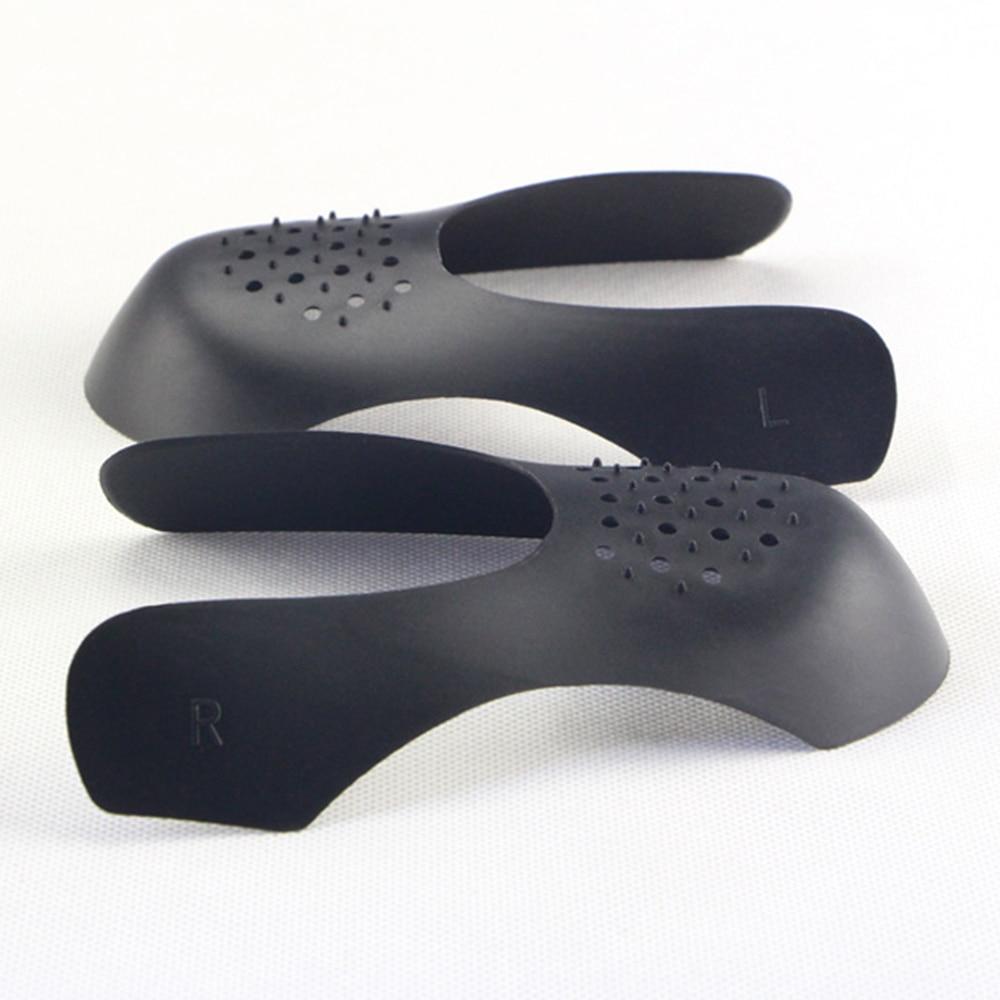
Universal Anti-Crease Sneaker Shields - 1 Pair (Left + Right) Toe Box Crease Protectors
Universal Anti-Crease Sneaker Shields - 1 Pair (Left + Right) Toe Box Crease Protectors
Couldn't load pickup availability
Toe box crease protection
The crease starts in one place. This sits in that place.
A sneaker creases at the toe box because that is where the upper folds every time you push off. These are thin moulded shields that drop into the toe of the shoe and hold that panel out, so the flex spreads across the whole cap instead of collapsing into one hard line.
They go in once, stay in while you wear the shoes, and come out when you want them out. Nothing is glued, stitched or permanent.
Read this before you order
One order is one pair. Two shields — a left and a right.
We are saying this plainly because this page used to say something else. An earlier version of this description promised two pairs, a soft set and a firm set. That was wrong, a buyer told us so in a review, and the supplier's own packing list confirms it: one pair per order. Two shields, shaped as a mirrored left and right, enough for one pair of shoes.
There is no soft version and no firm version. There is one shell, in two colours and two size ranges, and you pick the colour and the size range at the top of this page.
How it actually works
It spreads the fold instead of stopping it.
Your shoe has to bend. The shield does not fight that — it changes where the bending happens. A domed shell inside the toe box carries the load across its whole curve, so the leather or mesh above it flexes over a broad arc rather than buckling into the single deep line that becomes a permanent crease.
That is the honest mechanism, and it sets the honest expectation with it. These prevent new creasing. On a shoe that already has a crease, holding the toe box out makes that crease sit shallower and read less while the shoe is worn or stored — which is what the original listing meant by restoring and improving old-looking kicks. It is not an iron. A crease that is already set into the upper does not disappear.
Put them into a new pair on day one and you get the most out of them. Put them into a pair you already wear and you stop the damage getting worse.

Sizing — read the scale, not just the number
These numbers are EU shoe sizes.
This matters more than anything else on the page. The two options are labelled with European shoe sizes, because that is the only scale the manufacturer publishes for this product. If you read "35–39" as a US size you will order the wrong one.
Your sneakers almost certainly already tell you your EU size. Look at the size label sewn into the tongue or printed inside the collar: most sneakers list US, UK and EU together on the same label. Use the EU number you find there.
We have deliberately not printed a US or UK conversion here. The manufacturer does not publish one for this product, and the third-party listings that do invent one disagree with each other by several sizes. We would rather send you to the EU number already printed on your own shoe than guess on your behalf.
The shells are also trimmable, which is the manufacturer's answer to the gap between two size bands: if a shield sits proud in a shallower shoe, the edge of the tongue can be cut back with scissors. Take a little off at a time — you cannot put it back.
Living with them
In the shoe, or in the closet.
Perforated, not solid
The domed cap is pierced with a field of small holes, so the shield is not a sealed plastic cup sitting over your toes. Air moves through it the way it moves through the shoe.
You stop noticing them
The shell is thin and slightly flexible rather than rigid, and it sits above the toes rather than under them. In a shoe with normal volume in the toe box you feel it for a wear or two and then you forget it.
They double as shoe trees
Leave them in when the shoes go back on the shelf and they keep the toe box standing up instead of slumping. They pack flat for travel, which a wooden shoe tree does not.
What they suit
Best where there is room above the toes.
These were designed around the classic low-top leather sneaker — the round, deep, generous toe box that creases in one obvious line across the front. That is where they do their most visible work.
They also go into boots, court shoes and smarter lace-ups, as long as there is volume above your toes for the shell to occupy. Where they are least at home is anything cut close and flat over the foot: a slim racing runner, a low-volume dress shoe, a shoe you already wear snug.
The practical test is your own foot. Put them in, lace up as normal, and walk. If the shoe feels tight across the top of the toes rather than merely different, that shoe has no room for a shield and no size of shield will change that.

Specification
What we can stand behind.
Figures marked supplier-specified come from the manufacturer's own listing for this product. We have not published a thickness or a weight here, because the only figure available to us is a caliper reading in a supplier photograph rather than a datasheet, and we are not going to print a measurement we cannot source properly.
Questions people ask
How many shields come in one order?
Two — one pair, a left and a right, enough for one pair of shoes. Not two pairs. An older version of this page said two pairs and it was wrong; the manufacturer's packing list says one pair and that is what ships.
Are 35–39 and 40–46 US sizes?
No. They are EU sizes. Check the size label in the tongue or collar of your sneaker — it will almost always list the EU number next to the US one. Use that.
Will they get rid of the creases I already have?
Not permanently. What they do is hold the toe box out, which makes an existing crease sit shallower and look less obvious while the shoe is on or stored, and stops new creases forming on top of it. A crease already set into the leather is not something a shield can iron out.
Do I take them out to wear the shoes?
No — they are made to stay in while you wear them. That is the point: the crease forms while you walk, so the shield has to be there while you walk.
Can I feel them on my toes?
Most people notice them for the first wear or two and then stop. They sit above the toes, not under them, and the shell is thin. If a shoe is already snug across the top of the foot, expect them to be noticeable in that shoe.
Do they work in shoes other than sneakers?
Yes, wherever there is room above the toes — boots, lace-ups, court shoes. They were designed around the deep round toe box of a low-top leather sneaker, which is where they fit most easily.
What if they are slightly too big for my shoe?
They can be trimmed. Cut back the edge of the flat tongue with scissors, a little at a time, until the shield seats cleanly. Cut too much off and you cannot undo it, so go slowly.
Can I wash them?
Yes. Rinse them, wipe them down and let them dry fully before you put them back in the shoe.
Keep the toe box you paid for.
Two shields, in the shoe, doing the one job that decides whether a sneaker still looks new in a year.