Top-Mount Pull-Out Wardrobe Hanger Rail – Extendable Adjustable Closet Rod for Hanging Clothes, Trouser Organization, Maximizing Wardrobe Space Neatly and Efficiently
Top-Mount Pull-Out Wardrobe Hanger Rail – Extendable Adjustable Closet Rod for Hanging Clothes, Trouser Organization, Maximizing Wardrobe Space Neatly and Efficiently
Couldn't load pickup availability
The trousers at the back of the closet are the ones you never wear
Not because you do not like them. Because you cannot see them. Folded over a rail they crease at the knee; stacked on a shelf they end up at the bottom of the pile; hung at the back of a deep closet they are behind everything else and you would have to move three coats to check.
This is the fix, and it is a simple one: a short rail that screws to the underside of a shelf and slides straight out on a ball-bearing track. Pull it, and the whole row comes to you at once — every pair face-on, at eye level, in daylight. Push it back and it disappears under the shelf again.
It takes the dead air under a shelf and turns it into the most usable space in the closet. Nothing sits on the floor, and nothing gets folded.

How it mounts, and why that matters
This is a top-mount rail. A flat steel flange runs along the top of the housing with countersunk holes in it, and it screws upward into the underside of a shelf or the top panel of a closet bay. It does not clamp to an existing rod and it does not need side walls at a particular spacing — it hangs from the surface above it.
The pull-out action is a ball-bearing drawer slide running along the top of the housing. The chrome hanging bar is fixed below, so the bar and everything on it travel forward together. That is the whole mechanism — there is nothing to adjust, tension or lubricate.

Two rail styles, and the difference is real
The listing carries two builds of the same idea. They are easy to tell apart once you know what you are looking at.
Both mount the same way and both pull out the same way. The choice is about how much hardware you want to see, not about what it does.
Read this before you choose a size
The length you pick is the length of the rail itself. It is the run of hanging bar you get, and it is how far back into the closet the rail sits. Measure the depth of your closet, front to back, and choose a rail that fits inside it — not one that matches the width of the opening.
We are not going to quote you a pull-out travel figure. The supplier publishes a length and a height for each model and nothing about how far the slide runs when you draw it forward. Rather than make a number up, we have left it out. If the exact extension is what your build depends on, ask us before you order and we will go back to the supplier.
An older version of this page said "Size: 13.8 inches" as though there were one size. There is not. 13.8 in (35 cm) is one rung on a ladder that runs from 11.8 in (30 cm) to 21.7 in (55 cm). That line has been removed and replaced with the full range below.
Will it fit? Measure these four
These are the supplier's published figures for this hardware, not measurements we have taken ourselves. Measure your own closet before you order.

What actually arrives
One rail, in the length and finish you choose. That is it. Every photograph of this rail — ours and the supplier's — shows it loaded with a row of slim trouser hangers, because that is what it is for. Those hangers are not in the box. They are sold separately, and they are listed on this same page further down the option list.
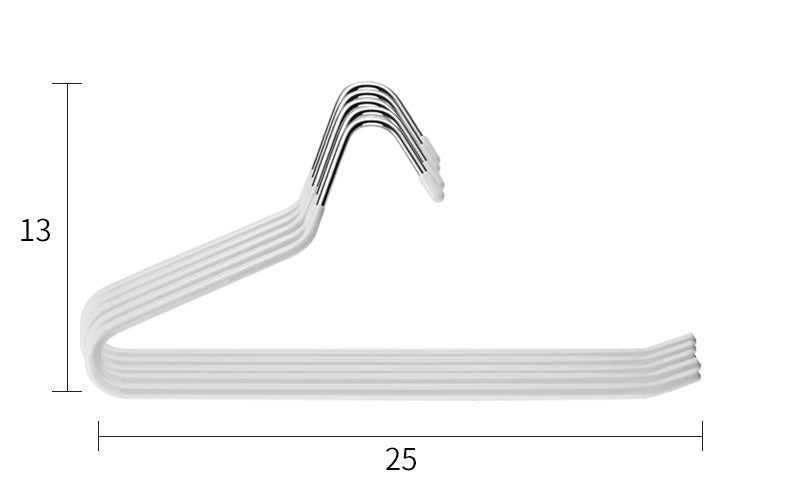
The hanger packs are the matching open-ended type: a hook, a straight bar, and one open end so trousers slide on from the side without being folded over anything. They come in two sizes — 9.8 x 5.1 in (25 x 13 cm) and 11.4 x 5.5 in (29 x 14 cm) — in packs of 10 or 20, in white or black.
We do not have a packing list from the supplier, so we are not going to promise you a particular set of mounting screws or printed instructions with the rail. Assume you may need to supply your own fixings for the shelf you are mounting into — which is sensible anyway, since the right screw depends on whether you are going into chipboard, ply or solid timber. If that matters to you, ask us before you order and we will check.


Where it earns its place
Deep closets, where the back half is currently wasted. Fitted wardrobes with a tall bay and one long drop. Small apartments, where the only way to gain space is upward. And anyone who owns more than a few pairs of tailored trousers and is tired of the crease that a folded hang puts across the knee.
Questions worth asking before you order
Do the hangers come with it?
No. The rail ships on its own. The hangers in the photographs are the packs listed separately in the option list on this page. It is the single most important thing to know before you order, which is why it is said twice.
Which length should I buy?
Measure the inside depth of the closet, front to back, and go one size down from it. A rail longer than the closet is deep will not fit; a rail much shorter than the closet simply gives you less hanging bar than you could have had.
Can I fit two side by side?
Yes, and it is a common way to use them — the supplier's own fitting diagram shows a pair under one shelf. Each rail wants about 9.8 in (25 cm) of width, so a bay a little under 24 in (60 cm) wide takes two.
Does it need to go under a shelf, or can it go on the closet wall?
Under a shelf. The mounting flange faces upward and screws into the surface above the rail. There is no side-wall bracket, so a bay with nothing overhead is not a fit for this.
How much weight will it take?
We do not have a load rating from the supplier and we are not going to invent one. It is a metal housing on a ball-bearing slide and it is built to carry a row of trousers, which is what every photograph of it shows. If you are planning to hang something heavy from it — a row of winter coats, say — ask us first and we will get the figure before you buy.
What is the difference between the black, white and grey?
Finish only. Pick the one that disappears into your closet interior — white against a white melamine carcass, black against oak or walnut. Grey is the middle option and, at the time of writing, the grey rails are out of stock.
Why are hangers and rails on the same page?
Because they are sold as one family and the hangers are sized to match the rail. We have relabelled the option list so it is obvious which is which — every entry now says whether you are buying a rail or a pack of hangers, and in what size.