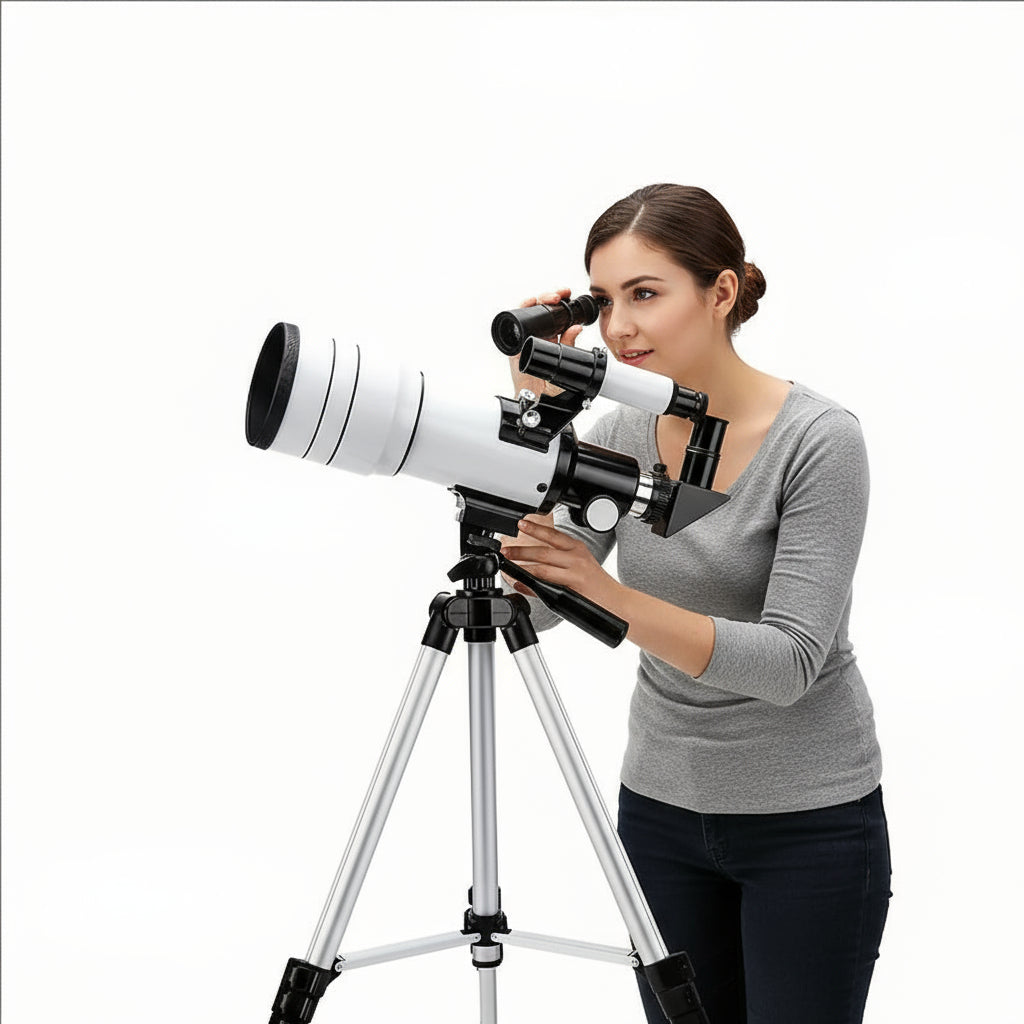
Professional Astronomical Telescope – F30070 High-Magnification Optical Scope for Stargazing, Moon & Bird Observation
Professional Astronomical Telescope – F30070 High-Magnification Optical Scope for Stargazing, Moon & Bird Observation
Couldn't load pickup availability
The moon is the thing that hooks people
Everyone points a first telescope at the moon, and it is the view that does the work. Craters along the terminator line, shadowed rims, mountain ranges throwing shadows across the surface — sharp, unmistakable, and far more affecting in person than in any photograph.
This is a 70 mm refractor built for exactly that: something a beginner or a child can carry into a garden and get a real result from on the first clear night.

Aperture is the number that matters. Magnification is the number you get sold.
Telescopes at this price are advertised on magnification, and it is the wrong figure to shop on. What decides how much detail exists to be seen is aperture — how much light the front lens gathers. This one gathers it through a 70 mm objective, with a 300 mm focal length behind it.
There is a hard ceiling that follows from that. A lens can only usefully magnify to roughly twice its diameter in millimetres, so 70 mm tops out around 140x. Beyond that you are not adding detail, because there is no more detail in the light to add — you are just enlarging a blur. Opticians have a name for it: empty magnification. The image gets bigger, dimmer and softer all at once.
This kit reaches 150x at its highest combination, which sits right at that honest limit. If you see a scope this size advertised at 300x, 525x or 675x, those numbers are real arithmetic — a very short eyepiece stacked behind a Barlow — and a useless view. We would rather tell you where the ceiling is than print a bigger number on the box.

What you will actually see
Worth being blunt about, because the gap between the photographs used to sell telescopes and the view through a 70 mm eyepiece is where most disappointment comes from.
- The moon. Genuinely detailed, and the reason to own it. Craters, ridges, the sharp shadow line down the middle.
- Jupiter. A small bright disc with up to four of its moons as pinpoints in a line beside it. Their positions change from night to night, which is the part that gets people.
- Saturn. Small, but unmistakably not round — the rings read as a shape rather than a separate structure.
- Venus. A bright crescent or half-disc, phased like a tiny moon.
- Star clusters and the brighter nebulae. From a dark site, as faint grey smudges and scatters of stars.
- What it will not show. The coloured, frame-filling galaxies and nebulae in space photography. Those are long exposures through instruments many times this size — no 70 mm telescope shows them to the eye, and any listing implying otherwise is showing you a photograph, not a view.

It works in daylight, straight out of the box
An astronomical telescope normally shows you an upside-down image, which does not matter in space and matters a great deal when you are looking at a bird. This one ships with a 1.5x erecting eyepiece that puts the view the right way up, so it doubles as a spotting scope without buying anything extra — birds on a distant feeder, wildlife across a valley, boats out at sea.
That matters more than it sounds for a first telescope, because most evenings are cloudy. A scope that only works on clear nights is a scope that lives in a cupboard.

The eyepieces, and which one to reach for
Magnification is the focal length of the telescope divided by the focal length of the eyepiece, so 300 mm of telescope gives you:
- H20mm — 15x. Wide, bright and forgiving. This is how you find anything. Start here every single time.
- H6mm — 50x. The working magnification for the moon and the planets, and the one you will use most.
- With the 3x Barlow — 45x or 150x. The 150x combination is worth trying on a still, steady night and will look poor on a turbulent one. That is the atmosphere, not the telescope.
- With the 1.5x erecting eyepiece — 22.5x or 75x. Right-way-up, for daytime.

Be honest about the tripod
This is a light aluminium photo-style tripod with a pan handle, not an observatory mount, and on a small telescope the tripod is what most often spoils the view. At full 46 in height, a nudge or a breeze will set the image shaking for a second or two, and the higher the magnification the worse it looks.
The fix is free. Run the legs short, stand it on a table, a wall or a step rather than at full stretch, keep the centre column down, and let go of the tube before you look. Sitting down to observe is the single biggest upgrade available to a beginner, and it costs nothing.

What arrives
- Optical tube — F30070 refractor, 70 mm objective, 300 mm focal length, fully coated glass
- Two eyepieces — H20mm (15x) and H6mm (50x)
- 3x Barlow lens and a 1.5x erecting eyepiece
- 5x24 finder scope with mounting bracket
- Diagonal mirror, so the eyepiece sits at a comfortable angle
- Moon filter — screws onto an eyepiece to take the glare off a full moon
- Phone adapter for holding a camera to the eyepiece
- Aluminium tripod with pan handle and lock; 360° horizontal and 90° vertical movement; no tools needed to assemble
- Star chart, manual and warranty card
Sizes: tube about 11 in (28 cm) long and 5.5 in (14 cm) across. Tripod stands from about 16 in (40 cm) collapsed to about 46 in (117 cm) fully extended. Manual focus throughout — there is no motor and no tracking.

Never point it at the sun
A telescope concentrates sunlight, and looking at the sun through one causes permanent blindness in a fraction of a second. There is no warning sensation and no second chance. Never look at or near the sun through the telescope or through the finder scope, and never leave it set up unattended outdoors where a child might.
The filter supplied with this telescope is a moon filter. It takes the glare off a bright moon and it is not a solar filter — it must never be used to look at the sun. This applies to any small filter that screws into an eyepiece: those are known to crack from concentrated heat while you are looking through them. Safe solar observing requires a purpose-made filter that fits over the front of the telescope and blocks the light before it enters.
Frequently asked questions
Is it suitable for a child?
Yes, with an adult for setup and for the sun warning above. Manual focus and a simple mount are the right level — there is nothing to configure before you get a view. Expect to help with finding things for the first few nights.
How good is the finder scope?
It is a 5x24 optical finder, which is the standard fitting at this size and is adequate once aligned. Align it in daylight on a distant chimney or pylon before your first night out — centre the object in the main eyepiece first, then adjust the finder's screws until it agrees. Skipping this is the usual reason a first night is frustrating.
Why does everything drift out of view?
That is the Earth rotating, and it happens with every telescope that does not track. The higher the magnification, the faster things cross the field. Nudge the pan handle to follow — it becomes second nature within a night.
Can I photograph through it?
You can clamp a phone to the eyepiece with the included adapter and get a good moon shot. Planets are much harder and deep-sky astrophotography is out of reach here — that needs a tracking mount and long exposures, and is a different hobby with a different budget.
Will it work from a city?
The moon and the bright planets punch straight through light pollution, so yes for those, from a balcony or a back step. Faint deep-sky objects need darker skies — a drive out of town transforms what you can see, with this or any telescope.
Why is there a faint colour fringe around the moon?
A short two-lens refractor like this one brings colours to focus at very slightly different points, so bright edges can show a faint violet or green rim. It is normal for the design and is most visible at the highest magnifications.
Is this a step up from binoculars?
On the moon and the planets, clearly yes — 50x resolves detail no handheld binocular will. On wide star fields, good binoculars remain excellent and easier. This telescope's advantage is magnification on small bright targets and a steady mount to hold it.