Snow Mountain Glass Bowl – Decorative Tabletop Centerpiece with a Frosted Glass Peak
Snow Mountain Glass Bowl – Decorative Tabletop Centerpiece with a Frosted Glass Peak
Couldn't load pickup availability
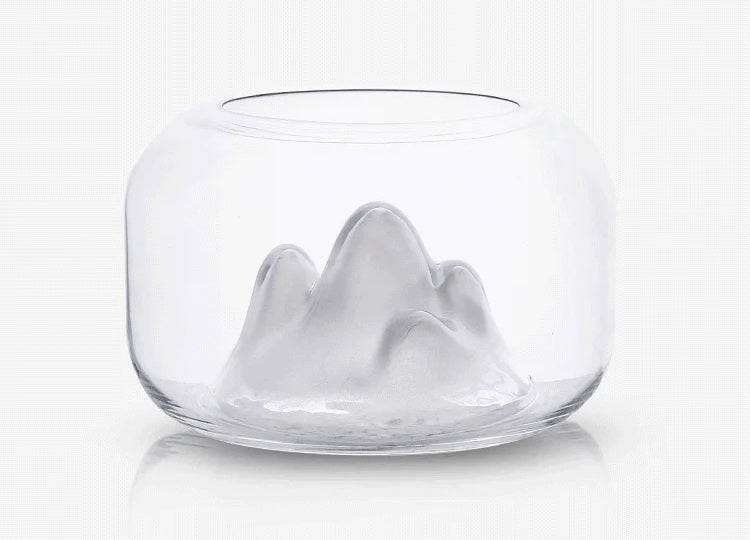
A heavy glass bowl with a frosted mountain moulded into the floor of it
Fill it with still water and the frosted peak reads as a snowy ridge rising out of a flat white lake. That is the whole idea, and it works because the glass is thick: the walls hold the water dead still and the wide, shallow shape gives the surface enough room to act like a mirror. It sits low and wide — about as wide across as an adult's open hand — so it belongs on a desk, a shelf, a windowsill or the middle of a table rather than on the floor. You can choose the plain clear bowl on its own, or the smoked-grey bowl on a round wooden base that lights the peak from underneath.
Read this before anything else: this is an ornament, not an aquarium. The earlier version of this page called it a fish tank and showed a full-grown goldfish swimming in it. It is far too small to keep any fish. Allowing for the solid glass peak that takes up the middle of it, we estimate it holds on the order of two cups of water — and it has no filter, no heater, no air pump and no lid. We have taken the fish out of the photographs and out of the copy, and we would ask you not to put one in. Everything below describes what it is genuinely good at.
What it actually is
- One piece of glass, not an assembly. The mountain is not an ornament dropped in the bottom. It is frosted glass formed as part of the bowl, so there is nothing to lift out, nothing to lose and no seam to trap dirt.
- Wide and shallow, not tall. The maker's dimension drawing gives it as about 5.8 inches across at its widest and about 3.7 inches tall, narrowing to a 3.4 inch opening at the top. The shoulders curve inward, which is what keeps the water from slopping when you move it.
- Heavy-walled, with a thick flat foot. You can see the wall thickness in the glass at the base. It is the reason it feels like an object rather than a jar, and the reason it sits still on a desk.
- Two versions. The clear bowl is exactly that: glass and nothing else, no cord, no switch, no electronics. The lit version is a smoked-grey bowl sitting on a round pale-wood base with one small push button on the side; the light glows up through the peak from below.
- It ships empty. No water, no stones, no plants and nothing living. What arrives is the glass.
The measurements, and where they come from
About those numbers, honestly. The three dimensions are the maker's own, taken off its drawing. The capacity is ours, calculated rather than measured, and we have said so rather than rounding it into a spec. We hold no figure at all for the weight, for the glass composition, or for how the lit base takes its power — whether it charges by cable or takes a cell. If any of that matters to you, ask us before you order and we will find out rather than guess.
What people actually use it for
- Still water and nothing else. The plainest version and the best one. Cold tap water, filled just past the lower slopes so the peak breaks the surface. Change it every few days.
- A floating candle or a single flower head. The wide mouth and flat surface suit one tealight in a floating holder, or one bloom cut short and laid on the water.
- Air plants, kept dry. Tillandsia sit happily on the glass around the peak with no soil and no water in the bowl. Take them out to soak them, and put them back when they have dried.
- Empty, as a sculpture. It reads perfectly well dry on a shelf. The frosted peak is the point; the water is optional.
- A night light, if you take the lit version. Warm and low rather than bright. It lights the peak and a small pool of table around it, not the room.
Looking after it
- Hand wash in cool water. A soft cloth and mild soap. It is not a dishwasher item and the lit base must never go near water at all.
- Never pour boiling water into it. We do not know what glass this is, which means we cannot promise it will take thermal shock. Treat it as ordinary glass: no kettle, no freezer, no hot-to-cold jumps.
- Limescale is the thing that spoils it. Hard water leaves a tide mark on the frosted peak. A short soak in white vinegar and a rinse takes it off; a scouring pad will scratch the frosting permanently.
- Keep it off the edge. Full of water on a thick glass foot, it is heavy enough to break a tile floor and itself. Put it somewhere it will not be knocked.
In the box
- One glass bowl with the frosted peak formed into it, in the version you choose
- The round wooden lit base, on the lit version only
- No water, no stones, no plants, no candle and nothing living
What changed on this page. The previous description sold this as a fish tank and an aquarium lamp. Both were wrong. It is much too small to house any fish, and the cheaper of the two versions has no light in it whatsoever — it is a plain glass bowl — so an entire section about ambient LED lighting described something that variant does not have. We removed the animal framing, removed the lighting claim from the version that has no light, replaced the maker's photographs with our own, and set out the three dimensions the maker actually publishes alongside the one number we had to work out ourselves. Where we do not know something, this page now says so.
Share