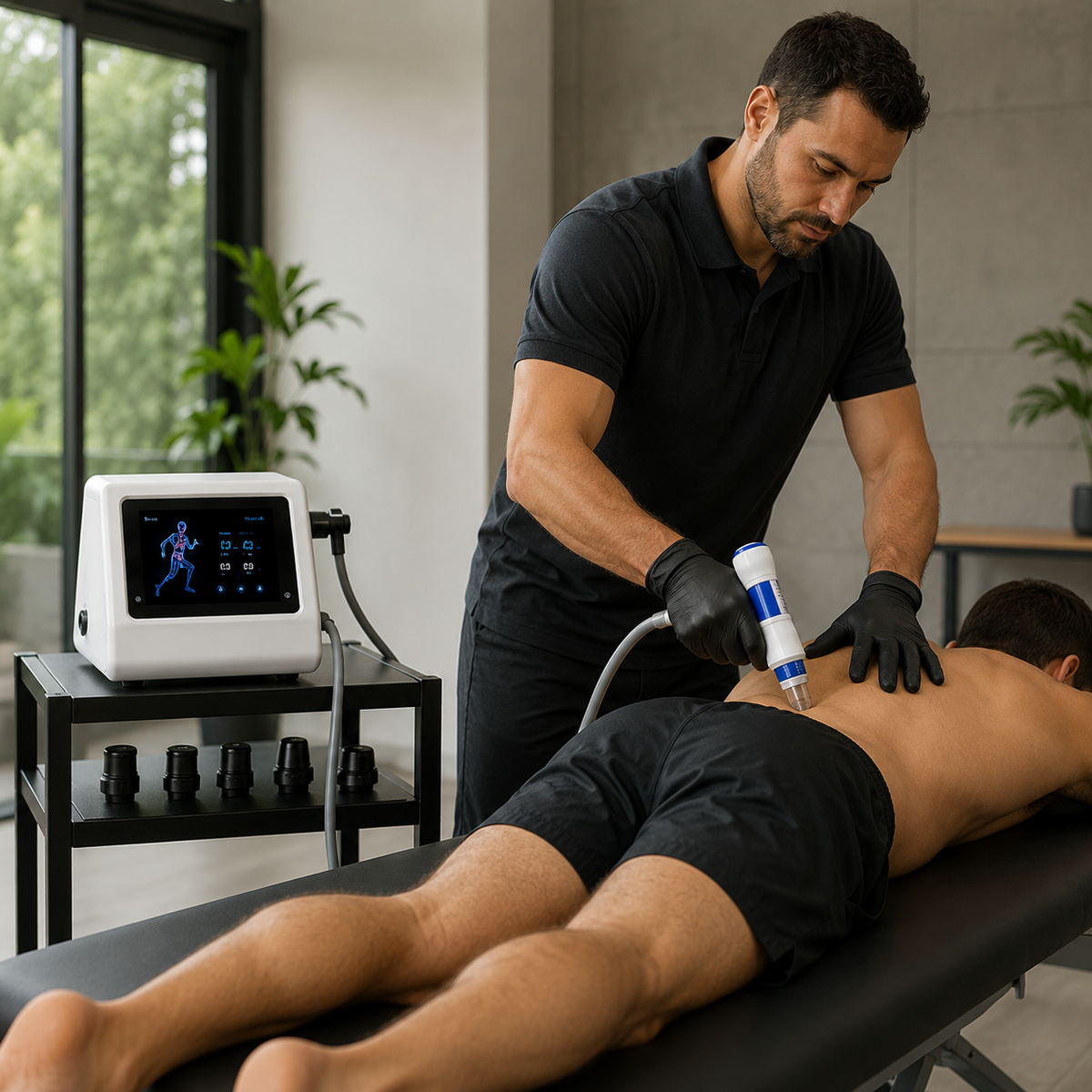
Shockwave Therapy Machine
Shockwave Therapy Machine
Couldn't load pickup availability
Move Better Without Planning Around the Same Stubborn Spots
When the same heel, calf, shoulder, elbow, or back area keeps tightening up, a quick pass with a massage gun can feel too broad—and another appointment means more time, more cost, and more waiting.
The 12-Mode Shockwave Therapy Machine gives you a more targeted, adjustable way to work on sore, tight soft-tissue areas on your schedule. Choose a guided program, select the contact head, and fine-tune the session from the touchscreen.

Target the Area—Not Just the Surface
The handpiece delivers rapid radial pressure pulses through the applicator at the point of contact. That concentrated mechanical action lets you focus on a specific muscle or soft-tissue area instead of vibrating an entire limb.
Use a smaller contact head when you need precision and a broader head when you want to cover a larger area. The result is a session that feels deliberate, adjustable, and built around the spot that needs attention.
Relief You Can Fine-Tune
Twelve guided programs give you a clear starting point. Adjustable frequency and intensity let you tailor the pace and feel of the session rather than accept one fixed setting.
Start conservatively, assess comfort, and increase only within the supplied instructions. More power is not automatically better; the value is having the control to find an appropriate setting for the area and the person.
Five Interchangeable Heads. More Ways to Target.
Different areas call for different contact profiles. The five applicator heads give you narrower and broader options for calves, heels, shoulders, elbows, back, and other muscular or soft-tissue areas.
Choose the head recommended by the supplied manual or a qualified professional for the area and intended protocol.
A More Deliberate Alternative to a Massage Gun
A massage gun uses rapid percussion from a handheld motor. This tabletop system uses a connected pressure-wave handpiece, guided programs, and adjustable session parameters. It is larger, more substantial, and intended for focused sessions—not casual all-over massage.
That distinction matters: this is not a pocket recovery tool. It belongs on a stable surface with enough room for the handpiece, cable, and applicators.
Where Radial Pressure-Wave Therapy Is Commonly Used
Across the broader radial pressure-wave and extracorporeal shockwave category, clinicians commonly use the technology in treatment plans for plantar heel pain, Achilles and patellar tendon problems, tennis elbow, shoulder calcific tendinopathy, and myofascial pain or tightness.
Those uses describe the category—not a guarantee that this specific unit will resolve a diagnosis. Results depend on the condition, device, protocol, operator, and individual response.
What This Therapy Usually Costs by the Visit
Radial pressure-wave therapy is rarely sold as a single appointment. Clinics generally work in courses—commonly three to eight sessions, once or twice weekly—because the effect accumulates across the series rather than arriving in any one visit.
In the United States a session commonly runs $200 to $300, with the wider range spanning roughly $200 to $600 depending on the clinic, the area, and the protocol. Most commercial insurance plans do not cover it. That puts a completed course somewhere between $1,200 and $2,500—for one area, on one person, just this year alone.
Where the Arithmetic Changes
The expensive part of this therapy was never the machine. It was access to the machine, metered by the visit.
Owning the emitter changes what you are actually paying for. The course you complete this spring costs the same as the one you repeat next spring: nothing. So does the session you run on a shoulder instead of a heel. So does the one you give your partner.
| A course at a clinic | Owning the system | |
|---|---|---|
| Cost | $1,200 – $2,500 | $999.99, once |
| Sessions | 3–8, then billed again | Unlimited |
| Areas | Charged per area | All of them |
| People | One | Everyone in the household |
| Scheduling | By appointment | The evening it flares |
| Afterward | Nothing | The machine |
One System, Every Area, Everyone in the House
Five applicator heads and twelve guided programs mean the same unit works the calf, heel, shoulder, elbow, back, and thigh. There is no per-area charge and no per-person charge. A household that would otherwise book two separate courses books none.
And because the system is yours, the 90-day return window is long enough to run a complete course the way a course is meant to be run—not a trial of one or two sessions, but the full series, before you decide whether to keep it.
Built to Be Used, Not Replaced
The main unit is rated for up to 80 million shocks, with reliable performance over five to ten years of regular use.
A typical session runs 1,500 to 3,000 impulses. Against a rating like that, the practical limit on this system was never going to be the hardware—it is how many years you keep it on the shelf. That matters for one reason: it means the price divides.
| Courses completed | Sessions | Your cost per session |
|---|---|---|
| One | 6 | $167 |
| Two | 12 | $83 |
| Four | 24 | $42 |
| Eight | 48 | $21 |
A clinic charges $200 to $300 for every one of those sessions, every time, for one area, for one person.
At $999.99 the machine now costs less than the cheapest version of that course. Every course after the first is simply free—the second one, the one next spring, the one on a shoulder instead of a heel, the one you run for your partner.
Paying With HSA or FSA Funds
This is a therapeutic device, and expenses for medical care are often reimbursable through a Health Savings Account or Flexible Spending Account. For many buyers that turns the purchase into pre-tax money rather than post-tax money.
How it works today. We do not currently process HSA or FSA cards directly at checkout. Many customers pay with a regular card and then submit the purchase for reimbursement through their plan.
Most plans require a Letter of Medical Necessity from your healthcare provider. Eligibility and documentation requirements vary by plan, so check with your plan administrator before purchasing.
What a Session Feels Like
Expect fast, repetitive pulses and a firm tapping sensation at the contact point. Sensitive or irritated areas can feel uncomfortable, especially at higher settings.
Begin at the lowest appropriate setting, keep the handpiece moving as directed, and stop if the sensation becomes sharp, unusual, or difficult to tolerate.
How to Use the System
Read the complete operating manual before the first session. A typical setup follows these steps:
- Place the main unit on a stable surface and connect the handpiece and power components exactly as directed.
- Choose the applicator head recommended for the contact area and apply coupling medium when the manual requires it.
- Select a guided program or begin with the lowest appropriate frequency and intensity.
- Apply the head to the intended soft-tissue area and move it according to the supplied technique and timing instructions.
- Stop the session, clean the contact components as directed, and store the heads and handpiece securely.
What Comes With the System
The system is configured around the main touchscreen control unit, the connected shockwave handpiece, five interchangeable applicator heads, the required power connection, and operating instructions.
Keep every component together so the system is ready to set up, use, clean, and store without searching for loose parts.
Know What You’re Buying
This is a full-size radial pressure-wave system. It is not a focused shockwave device and should not be assumed equivalent to every clinic-owned system. Technology, output, protocols, indications, and training requirements vary widely across the category.
Use it to supplement an informed recovery plan—not to self-diagnose unexplained pain or replace an evaluation when symptoms are severe, worsening, or persistent.
Important Safety and Suitability Information
Because contraindications vary by device and treatment area, review the supplied manual before use and ask a qualified healthcare professional whether the system is appropriate when you are treating an injury or medical condition.
Get professional guidance before use if you are pregnant, under 18, taking blood-thinning medication, have a bleeding or clotting disorder, impaired circulation or sensation, an infection or open wound, malignancy in or near the area, an implanted or prosthetic device near the area, recent surgery, or any uncertainty about where or how to apply the system. Never use it on an area prohibited by the manual.
Give Your Recovery Routine More Control
When you want more precision than a one-setting massage tool and more flexibility than another scheduled appointment, this system gives you guided programs, adjustable output, and five contact heads in one tabletop setup.
Add the 12-Mode Shockwave Therapy Machine to your cart and build a more deliberate recovery routine around the areas that need your attention most.