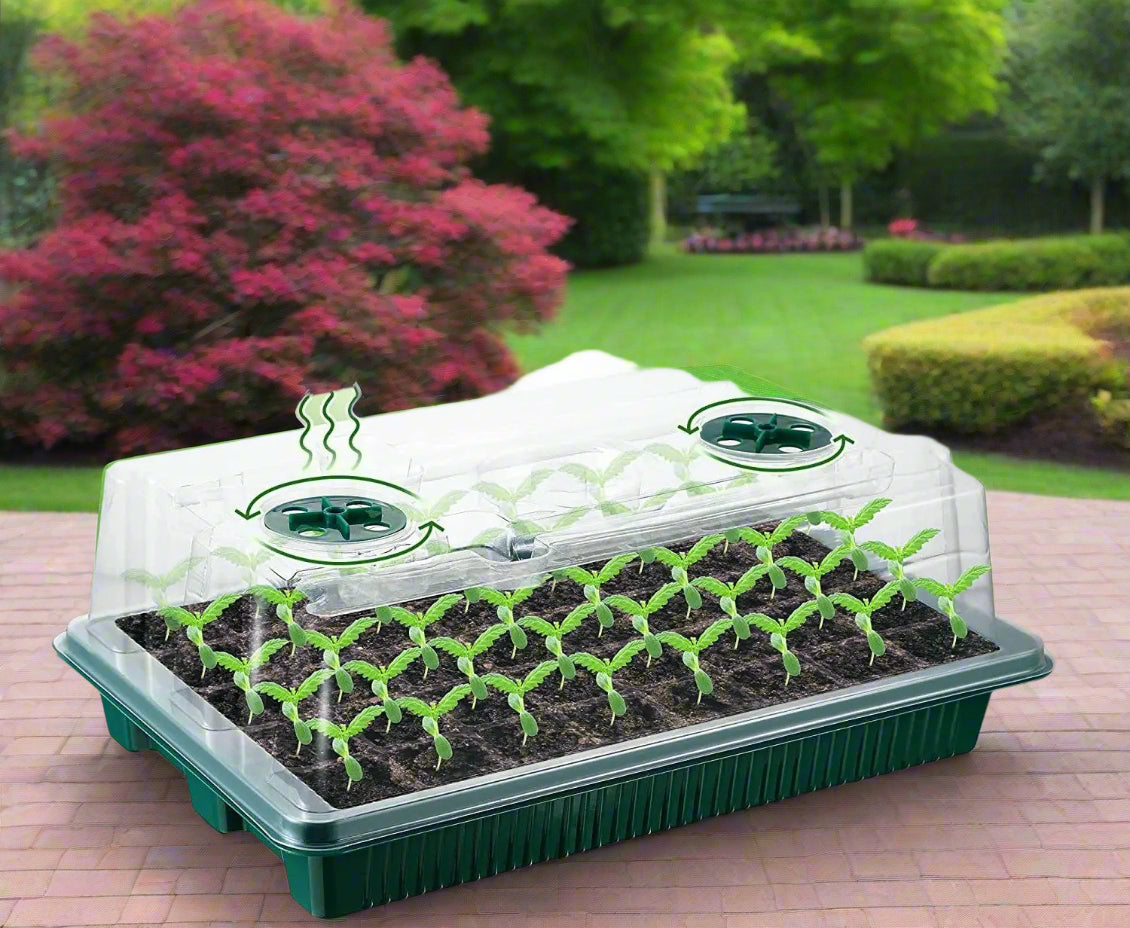
Seed Starter Trays with LED Grow Lights – 2 Trays, 40 Cells Each (80 Cells Total), High Dome Germination Kit for Winter Seedlings & Indoor Growing
Seed Starter Trays with LED Grow Lights – 2 Trays, 40 Cells Each (80 Cells Total), High Dome Germination Kit for Winter Seedlings & Indoor Growing
Couldn't load pickup availability
Start seeds in February and have real plants by spring
A windowsill in late winter gives seedlings maybe four usable hours of weak, sideways light. They germinate, then stretch toward the glass and go leggy. This is two complete propagators with their own lights, so germination stops depending on the weather.
The number in the title, said plainly
Eighty cells is the total across both trays, not eighty per tray. You get two trays of forty. The supplier's own sheet puts it as "40 cells x 2 tray", and we would rather you read that here than count it on your kitchen table. If you were planning eighty cells per tray, this is not that kit.
What you actually get
Measure your shelf before you order
Each tray is fifteen inches long and eleven deep. Two of them side by side want about thirty inches of clear run, and the dome adds three and a half inches of height on top of that, so a shelf with a low overhead will not take one. Most standard windowsills are not eleven inches deep. This is the single most common way a kit like this disappoints someone, and it is entirely avoidable with a tape measure.
If your sill is shallow, the trays sit happily on a table or a counter near the window instead — the lights are doing the work, so the window is a bonus rather than a requirement.
The lights, and what the buttons actually do
Four slim LED bars clip to the inside of the dome roofs, two per dome. They run off a single inline controller on a USB cord, which means they plug into a phone charger, a laptop, or a USB wall block rather than a mains socket. Nothing here carries mains voltage.
The controller carries three buttons and the supplier prints their behaviour on the housing:
- 3H — red light on a three-hour daily cycle
- 6H — blue light on a six-hour daily cycle
- 12H — red and blue together on a twelve-hour daily cycle
Set it once and it repeats each day on its own for as long as the USB supply stays connected. Pull the power and the cycle resets, so a switched socket that goes off at night will lose the timer. Brightness is adjustable on the controller as well.
Domes, vents and drainage
Each dome has two round vents you twist open and shut. Closed, the dome holds the humidity that gets seeds to crack; open, it lets the air move once they are up, which is what stops seedlings damping off. That is the whole reason a dome has vents rather than being a solid lid, and it is worth opening them the day the first leaves appear rather than waiting.
Every cell has a drainage hole in its base and sits inside a solid green tray, so water runs through the compost instead of pooling in it, and you can bottom-water by pouring into the tray and letting the cells take up what they need. The inserts lift out of the trays, so you can carry one to the sink without moving the other.
Everything is clear plastic apart from the base trays, which makes it easy to see roots reaching the sides — the sign that a seedling is ready to move on before it starts circling.
What ships
- 2 green base trays
- 2 clear 40-cell inserts (80 cells in total)
- 2 clear vented domes
- 4 LED grow light bars with one inline controller and a USB cord
- 20 plant labels
- 2 garden hand tools
Seeds, compost and a USB power source are not included.
What we are not going to tell you
An earlier version of this page gave one overall size that was actually close to the cell insert's own measurement rather than the base tray you put on your shelf, which is 15 x 11 in. We have listed every component separately instead, so there is nothing left to misread.
That page also gave the vents a specific humidity percentage range. A twist vent does not hold a humidity level to a number, and we have no measurement behind that figure, so it is gone. We have likewise not stated a specific number of brightness steps, a wattage, a PAR or lumen figure, or a diode spectrum in nanometres, because the supplier has not documented any of them. The lights are USB-powered and low voltage; we make no safety-certification claim for them because we have no certificate to point at.
Share