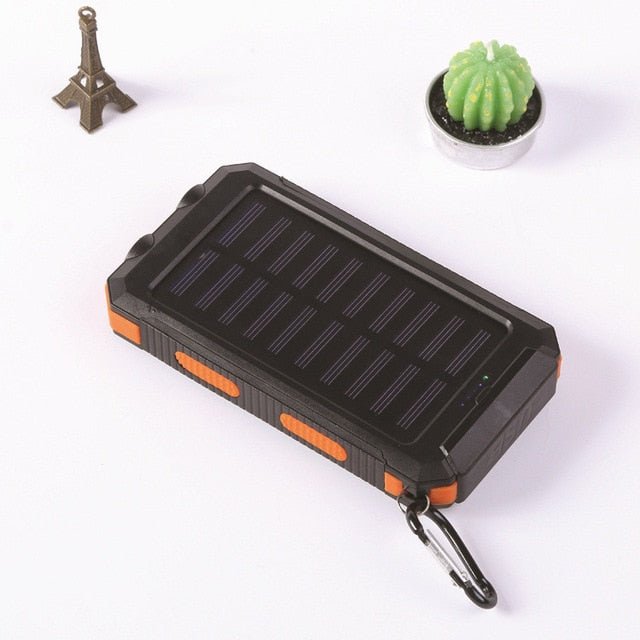
Solar Power Bank with Dual LED Light and Carabiner - USB-Charged Pocket Battery, Solar Panel for Emergency Top-Ups
Solar Power Bank with Dual LED Light and Carabiner - USB-Charged Pocket Battery, Solar Panel for Emergency Top-Ups
Couldn't load pickup availability
Solar Power Bank
A pocket battery you charge from the wall, with a panel on the front for when there is no wall
This is a USB power bank first. You fill it from a mains adapter, drop it in a bag, and it charges your phone from two USB sockets under a rubber flap. The solar panel across the face is a backup: in strong, direct, uninterrupted sun it will slowly put charge back in, over a long stretch of hours.
An earlier version of this page led with a promise of power that never runs out, while a note at the bottom of that same page quietly said the opposite. We have taken the promise down and moved the note to the top, because the note was the accurate half.
What the panel on the front actually does
Small solar panels produce small amounts of power. A panel this size, roughly the footprint of a phone screen, gathers a trickle. Left face-up in unbroken direct sunlight it will add charge across many hours. It will not fill an empty pack in a morning, and it will not keep pace with a phone you are actively using.
Charge it from a wall adapter for normal use. A standard USB adapter rated 5V/2A or better, through the micro-USB input, is how this pack is meant to be filled. Treat the panel as the thing you are glad of on day three with no outlet, not as your daily charger.
Some things reduce the trickle to nothing at all: cloud, shade, glass, low winter sun, the panel lying at an angle to the light, or the pack sitting in the shadow of your own backpack while you walk. Indoor light and dusk light do not charge it.
How much charge is in it
Here is the honest position. The manufacturer prints 20,000 mAh on the back of the casing. That is their figure, not a number we have measured, and we are labelling it that way deliberately. Unbranded solar power banks are routinely rated well above what they actually deliver, and this category is one of the worst for it.
Two things are worth knowing about any mAh figure on any power bank. It describes the cells inside at their own low voltage, not what reaches your phone, and stepping that up to USB voltage loses roughly a third of it along the way. So the useful number is always meaningfully smaller than the number on the box.
We would rather you buy this expecting a solid few phone charges from a full pack than expecting a week off-grid. If you need a capacity you can plan a trip around, buy a pack from a manufacturer that publishes a watt-hour rating and stands behind it.
What you can plug into it
Two full-size USB sockets out. One small micro-USB socket in. That is the whole port list, and it tells you most of what you need to know.
Two USB-A outputs
Ordinary full-size USB sockets, the rectangular kind. Bring your own cable with a USB-A plug on the charger end. Two devices can draw at once.
One micro-USB input
The small trapezoid socket between the two USB ports is how power goes in. If your cables are all USB-C, you will need a micro-USB cable for this pack.
No USB-C, no fast-charge protocol
There is no USB-C port anywhere on it, which means it cannot do USB Power Delivery. Expect ordinary USB charging speed, not the fast-charge rate your phone reaches on its own brick, and do not plan to run a laptop from it.
The light and the compass
Two LEDs in the end
Steady, SOS and strobe. It is a close-range work light: finding a tent zip, walking to the toilet block, looking under the car seat. It is not a torch for lighting a trail ahead of you, and no lumen rating is published for it.
A sealed button compass
A small liquid-filled compass is moulded into the top face. It is a novelty fitting, of the grade you find on a zip pull, and it sits beside a battery and a metal carabiner, both of which will pull a needle around. Enjoy it. Do not navigate by it.
We have left both of these described as what they are rather than dressed up, because they are the two features most likely to disappoint if you buy the page instead of the product.
Taking it on a plane
This matters more than most people realise, so here it is plainly.
- A power bank must travel in your carry-on. Lithium batteries are not permitted in checked baggage on any commercial airline. If it goes in the hold, it is being taken out at security or it is a problem in the air.
- This one sits in the easy band. The rule that needs airline sign-off begins at 100 watt-hours. On the manufacturer's own printed figure this pack is comfortably below that, so no approval is needed and no paperwork is involved.
- Keep the terminals covered. In the cabin bag, not loose in a tray of keys and coins.
Weather, water and rough handling
The casing is a hard plastic shell with soft rubber pads set into the corners and long sides, and a rubber flap over the port bay. That construction shrugs off knocks and grit, and the flap keeps dust and splashes out of the sockets when it is pressed shut.
There is no published water-resistance rating for this unit. No IP number, no immersion depth, nothing we can point at. So treat it as not water resistant: keep it out of sustained rain, do not leave it out in a downpour, and never put it in water. A rubber flap is a dust cover, not a seal, and a battery that has taken water in is a battery you throw away.
Specifications
Where a figure is not listed above, it is because our supplier does not document it and we are not prepared to print a number we cannot stand behind. Output amperage, panel wattage, LED brightness and case weight all sit in that category.
Buy it for what it is
A tough, pocketable USB battery with a clip, a work light and a panel that earns its place on the long trip where nothing else can reach an outlet.
Charge it from the wall Two USB-A out, micro-USB in Carry-on only, like every power bank Numbers attributed, not invented
Share