Paper-Thin Folding Laptop Riser - Portable Sit-Stand Desk for Desk, Bed and Lap
Paper-Thin Folding Laptop Riser - Portable Sit-Stand Desk for Desk, Bed and Lap
Couldn't load pickup availability
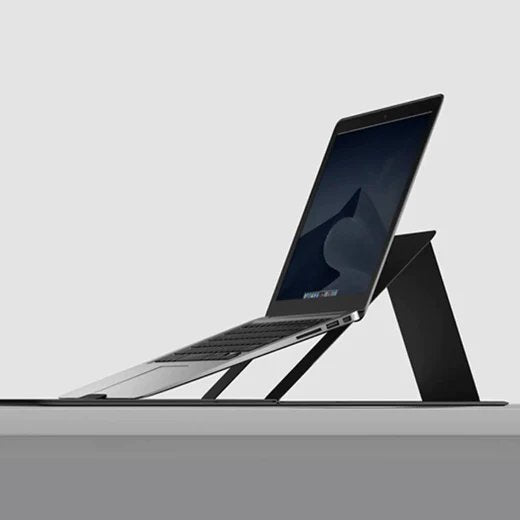
One flat black panel that unfolds into a desk, then lies down again.
Pick it up and it is a thin rectangle about the size of a closed laptop. Open the two legs out and it stands on your desk, your bed or across your lap and holds your screen up where your eyes already are. Fold it back down and it slides into the same sleeve your laptop lives in. There is nothing to screw together and nothing that comes apart.
This page has been describing the wrong object. It called this a mini table for study and reading, and suggested it as a snack tray and a nightstand. It is a folding laptop riser - a set of hinged panels that lift a laptop off the surface it is sitting on. It works on a bed and it will hold a plate, but selling it as a small table told you almost nothing about what you were getting.
We also removed a weight-capacity figure that came off a supplier graphic. We could not trace it to any manufacturer document, and the nearest branded version of this design publishes a number half its size, so we are not repeating it. Treat this as a riser for a laptop and the things you would normally have beside a laptop, and see the note further down about what the maker does not publish.
What it actually is
Hinged panels, not a folding table
It is one piece: flat rigid panels joined by creased hinges and finished in a matte black leather-look material. Set up, the top panel sits on two legs that each fold into a wide Z and splay outward, leaving an open triangle through each side. There are no knobs, no clamps, no telescoping tubes, no screws and no bag of hardware. That is why it can be as thin as it is, and it is also why it will never be a heavy-duty stand.
It has more than one shape
Opened all the way, it is a low table you set on a desk, a mattress or your thighs, tall enough to bring a laptop screen up toward eye level while you stand at an ordinary desk. Folded differently, it lies almost flat and lifts only the back edge of the laptop into a typing angle. Closed completely, it is a panel you can slide behind a monitor, under a mattress or into a laptop sleeve.
The point is the flat state
Plenty of things raise a laptop. Almost none of them disappear afterwards. If your desk is also your dining table, or your office is a different room each day, the fold-flat is the whole reason to choose this over a solid riser that lives on the desk permanently.
Where it earns its place, and where it does not
- Good: turning a normal desk into a stand-up desk for part of the day; getting a hot laptop off your legs on the sofa; working in bed without hunching; a shared or hot-desked space where nothing is allowed to stay on the surface; taking a working setup with you.
- Also good: propping a tablet or a book at a reading angle, and yes, holding breakfast on a bed - it just is not what it was designed around.
- Not for: heavy monitors, printers, or anything you would describe as equipment. This is thin folded panelwork resting on two edges.
- Not for a soft, uneven bed on its own. On a mattress the legs sink unevenly. It is noticeably steadier if you put it down on a firm book or a tray first.
- Not height-adjustable in the way a gas-lift riser is. It has the shapes it folds into, and that is the set you get.
Setting it up
Specifications
We are not publishing a weight limit, a folded or open dimension, a panel thickness, a product weight, a maximum laptop size or a material composition for this item, because the manufacturer does not publish them and we are not going to estimate numbers and present them as facts. Those are exactly the figures a shopper should get to check, so if any of them decides the purchase for you, ask us before you order and we will go back to the supplier for it in writing.
Looking after it
- Wipe it, do not wash it. A barely damp cloth on the surface and dry it off. The panels are board under a coated finish, so standing water is the thing to avoid.
- Fold it along its own creases. Do not force a panel the way it does not want to go. Hinged panelwork fails at the fold long before it fails anywhere else.
- Store it flat. Under a mattress, behind a monitor, in the laptop sleeve. Leaving it half-open under something heavy is what puts a permanent kink in a leg.
- Load it over the legs. Weight in the middle, not hanging off a corner.
A desk you can put away.
That is the whole idea. It lifts your screen when you want it up, and it stops existing when you want your table back. Open it on the desk to stand for an hour, drop it flat on the sofa to keep the heat off your legs, then slide it away and the room looks like nobody worked in it.
Share