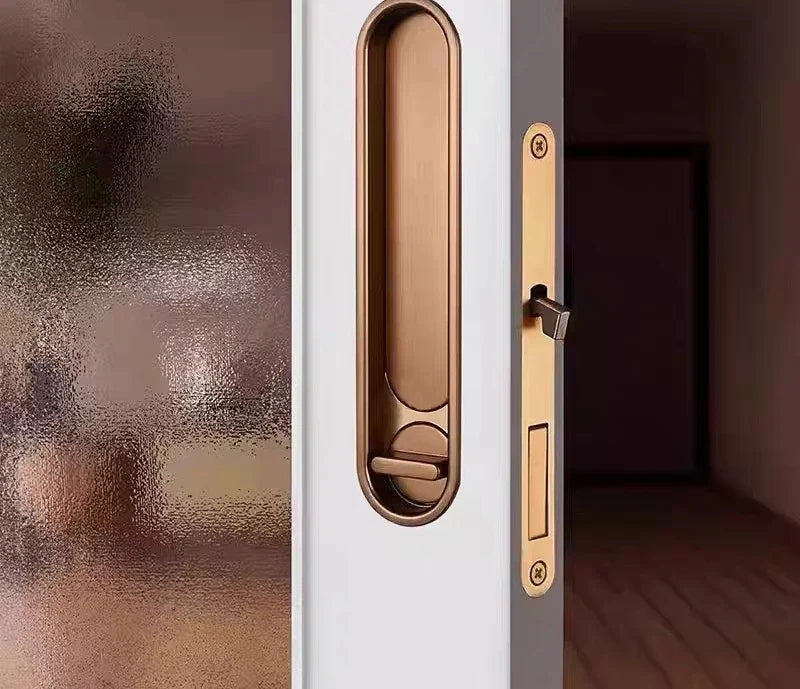
Invisible Entry Hook Pocket Door Lock – With Interior Lock Fittings, Modern Sliding Hardware for Doors, Rooms, or Minimalist Spaces
Invisible Entry Hook Pocket Door Lock – With Interior Lock Fittings, Modern Sliding Hardware for Doors, Rooms, or Minimalist Spaces
Couldn't load pickup availability
A pocket door has nothing to hold it shut
It hangs off rollers and slides into a wall. There is no frame for a bolt to bite into on the swing, and most pocket doors are sold with a finger scoop and nothing else. So the bathroom door drifts back open, and there is no way to signal that the room is occupied.
This is the fix, and the whole point is that it lives inside the door. A shallow oval plate sinks flush into each face. A slim strip sinks flush into the door edge. Turn the small bar on the plate and a short hook swings out of that edge strip into a keeper on the jamb. Turn it back and the door slides again.
Nothing stands proud of the door. On a pocket door that is not a style preference — the door has to carry its own hardware into a wall cavity, and anything raised above the face will catch on the way in.

The two faces are not the same, and that is deliberate
Look closely at the pair and you will see the plates differ at the lower end. One disc carries a small flat bar that stands a little above the disc face — that is the inside. You turn it with a thumb; it is the only control the lock has.
The other disc carries a narrow straight groove, sunk flush. That is the outside, and the groove is there so the latch can be released from the hallway with the edge of a coin or a flat screwdriver blade. It is the reason a set like this is fitted to a bathroom rather than a bare privacy bolt.
There is no keyhole on either face and no key in the box. That is by design, not an omission.

There is a second thing on that edge strip
Above sits the hook. Below it sits a small flat tab set into a rectangular recess — a finger pull that folds outward and drops back flush when you let go.
If you have ever pushed a pocket door too far and then had nothing to grip, that tab is the answer. It is the part buyers are most surprised to find, and on a true pocket door it is the difference between a door you can retrieve and one you cannot.

Read this before you order: it is a mortise lock
This is not a surface pull you screw on. A pocket has to be cut into the edge of the door for the lock case, and a shallow recess routed into each face for the plates. That cut cannot be undone, and it is why the fit numbers below matter more than anything else on this page.
If the door is already hung and you are not comfortable cutting into it, this is a job for a carpenter. Measure the door before you buy, not after.
What you have to cut, and what it fits
Figures are the manufacturer's published dimensions for this hardware and are confirmed against the supplier's own dimension drawing. Allow a small tolerance and check your own door before cutting.

What this lock is, and what it is not
- It is a privacy latch. It stops a sliding door being pushed open from the other side. That is the job it does well.
- It is not a security lock. There is no key, no deadbolt and no strike reinforcement. It is not rated against forced entry, and it releases from the outside with a coin by design.
- It is not a child-safety device. A child who finds a coin can open it, and a child inside can lock it. Do not use it where that matters.
- It is an interior fitting. Bedrooms, bathrooms, home offices, dressing rooms. Not an exterior or wet-exposed door.
In the box
- One complete lock set — two oval face plates, the mortise lock case with its edge strip and hook, the fold-out finger pull, and the keeper plate for the jamb
- Mounting screws
- An installation sheet, which the manufacturer supplies for reference — treat your own measurements as the authority
No cutting template, no router jig and no tools are included, and the coin used to release the latch from the outside is your own.
Four finishes, one shape
Matt Black is a flat, softly brushed black. Gray is a mid gunmetal with a satin sheen, closer to graphite than to silver. Gold is a bright warm champagne. Red Gold is a rose bronze, warmer and darker than the Gold.
The hook is stainless on all four, so expect a bright silver tongue against a black or gold plate. That contrast is the hardware, not a mismatch.