High-Capacity Portable Power Station – 39600mAh 146Wh Solar Generator with Dual AC Outlets, USB-C, LED for Outdoor & Emergency Use
High-Capacity Portable Power Station – 39600mAh 146Wh Solar Generator with Dual AC Outlets, USB-C, LED for Outdoor & Emergency Use
Couldn't load pickup availability
146 watt-hours is the number that matters
Every power station in this class is sold on a huge milliamp-hour figure, and ours is no exception — you will see 39,600mAh on the box. That number is real, but on its own it means nothing, and you should know why before you compare this against anything else.
Milliamp-hours only describe stored energy once you also know the voltage they were measured at. The 39,600mAh figure is quoted at 3.7 volts, the nominal voltage of a single lithium cell. Multiply the two and you get the honest answer: about 146 watt-hours. The same pack, measured at its actual 11.1-volt terminal voltage, would be printed as 13,200mAh — a third of the headline, describing exactly the same battery.
So ignore the milliamp-hours. When you compare this to anything else, compare watt-hours. That is the one figure that cannot be inflated by choosing a flattering voltage, and ours is 146.
100 watts is the ceiling, and it is a hard one
146Wh is how much energy is in the box. 100 watts is how fast it will let you take it out. Those are two different limits and confusing them is the single most common reason people are disappointed by a unit this size.
The two wall sockets share one 100-watt budget. Anything that draws more than that will not run, no matter how much charge is left. In practice that rules out an entire category in one line: if it makes heat, it will not work here. Kettles, coffee machines, hair dryers, toasters, microwaves, space heaters, hot plates and most blenders all draw several hundred watts to well over a thousand. None of them are candidates.
What does work is everything that charges or runs on small electronics: phones, tablets, laptops, cameras and camera batteries, drone batteries, handheld radios, portable speakers, laptop-sized monitors, LED string lights, a small desk or tent fan, a router, a games handheld, an electric blanket only if it is rated under 100W. That is a genuinely useful list. It is just not a generator.
Roughly, from a full charge and allowing for normal conversion losses: about six to eight full phone charges, about two full laptop charges, around two hours of running a laptop on the wall socket while you work, or something in the region of twelve hours of a 10-watt light or fan. Treat those as estimates derived from the 146Wh rating, not as tested figures — your own numbers will depend on what you plug in.
Before you buy, add up the watts. Look at the label or the power brick on the things you actually intend to run. If the total is under 100W you are fine. If it is over, this is the wrong size of unit and we would rather you knew that now than after it arrives.

What is actually on the box
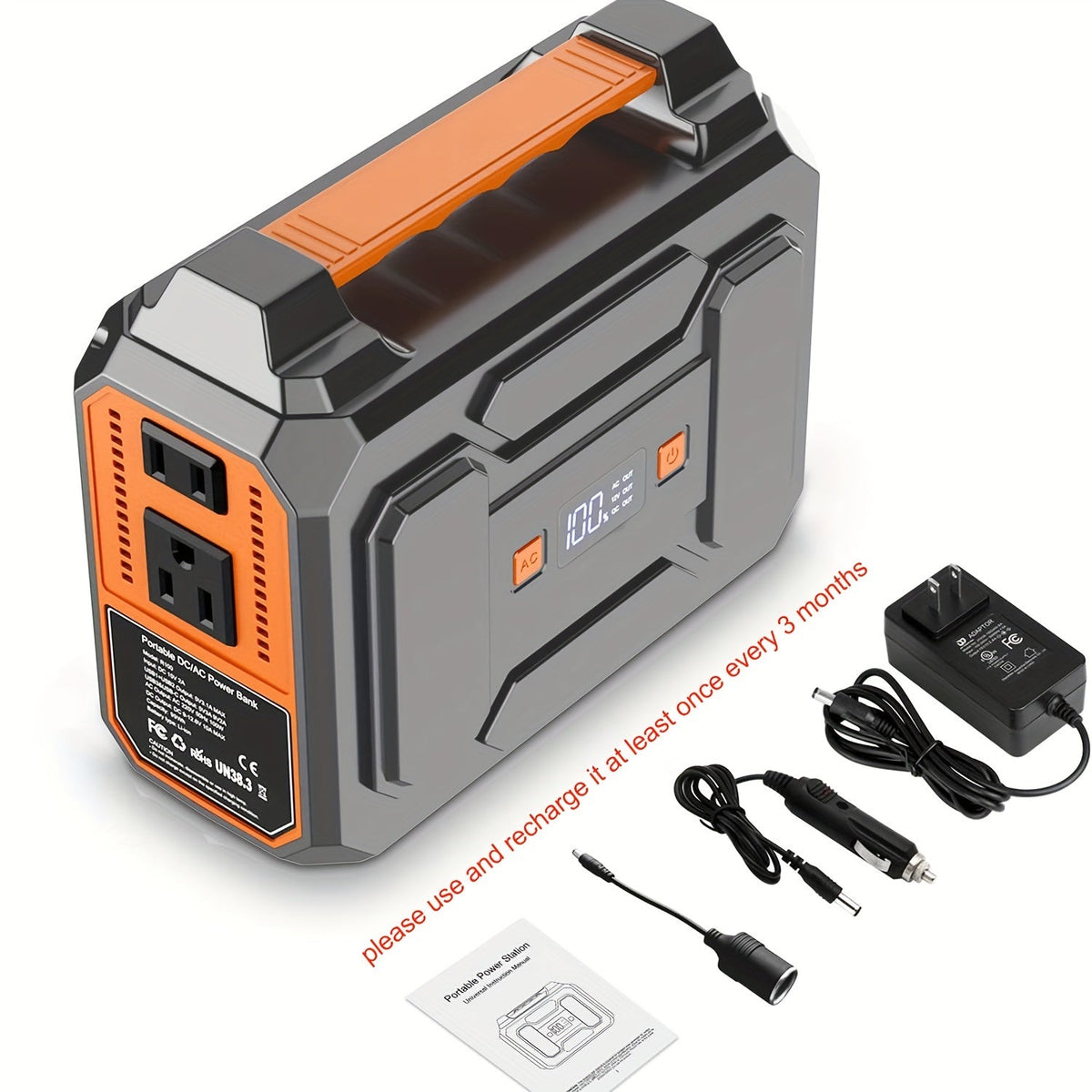
Seven output ports, spread across the two orange end panels, plus the light.
- Two 110V AC wall sockets — 60Hz, 100 watts total across both. Worth knowing before you buy: the lower socket is a full three-prong grounded outlet, the upper one is a two-slot socket with no earth pin. A grounded three-pin plug will only fit the lower of the two.
- Three USB-A ports — two rated 5V/3.1A between them, and a third quick-charge port rated 5V/3A and 9V/2A.
- One USB-C port — rated 5V/3A and 9V/2A. Note that this is an output only. You cannot recharge the unit through it.
- One 12V DC output — a barrel socket rated 9–12.6V, 10A maximum, for car-style accessories.
- A light — two small spotlights and a wide flood panel, on their own button, cycling through steady, strobe and flashing before switching off.
The wall sockets sit behind their own AC button. They stay off until you press it, which is what stops the inverter idling your battery flat overnight while you charge a phone off USB.

Three ways to fill it back up
Everything goes in through one barrel input rated 15V, 2 amps.
- From a wall outlet, using the supplied adapter — expect somewhere around five to six hours from empty.
- From a car, using the supplied cigarette-lighter cable, while you drive.
- From the sun, using a solar panel that matches the same 15V DC input.
No solar panel is included. This unit is listed as a solar generator because it will accept one, not because one is in the box. If you want to charge from sunlight you need to buy a compatible 15V panel separately, and how long it takes will depend entirely on that panel and on the weather.
If you are planning to fly with it, read this first
A 146Wh lithium battery sits above the threshold that airlines wave through without asking. Under FAA rules, lithium-ion batteries up to 100Wh travel freely in carry-on baggage. Between 101Wh and 160Wh — which is where this unit lands — the rules change:
- It must travel in carry-on baggage only. It cannot go in checked luggage.
- You need your airline's approval in advance. Not every airline will give it.
- You may carry a maximum of two such batteries.
This is not a formality and it is not our policy — it is the rule, and gate agents do enforce it. If your plan for this unit involves a plane, call the airline before you book. If it involves a car, a van, a boat, a tent or a kitchen worktop, none of the above applies.
Being straight about what we cannot tell you
Two things about this product are commonly claimed by sellers in this category, and we are not going to claim either of them, because we cannot show you the paperwork.
We do not claim a UL or ETL safety listing. Plenty of listings for units like this one do. We hold no North American safety certification documentation for this unit, so we say nothing about it. If a US safety listing is a requirement for you — for a workplace, a rental property, an insurer — buy something that can hand you the certificate.
We do not claim a pure sine wave inverter. This chassis is manufactured with both pure sine and modified sine inverters depending on the production run, and our documentation does not settle which one you will receive. For a laptop brick, a phone charger or a camera charger it makes no practical difference. For anything with a sensitive motor or a medical device — a CPAP machine in particular — it matters a great deal, and you should not buy this unit for that purpose on the strength of an assumption.
We would rather lose the sale than have you find that out at two in the morning.
Living with it
It is a sealed plastic case with a folding handle, meant to be picked up in one hand and set down somewhere. It is not weather-sealed and it has no ingress rating, so it belongs under the tent awning rather than out in the rain, and away from direct sun on a hot day.
The manufacturer's own instruction is worth repeating, because it is the thing most emergency kit owners get wrong: use it and recharge it at least once every three months, even if nothing has gone wrong. A lithium pack left flat in a cupboard for two years is not a backup, it is a paperweight. Put a recurring reminder in your phone the day it arrives.
The unit carries over-current and over-voltage protection, and will shut itself down rather than keep supplying an overloaded socket. If that happens, unplug whatever caused it and restart.
Specifications
Who this is right for. One person or one family keeping phones, tablets, laptops and lights alive through a camping trip, a long drive, a festival, a van weekend or a power cut that lasts a night rather than a week. It is quiet, it makes no fumes, and it can sit on the kitchen worktop indoors, which a gas generator cannot.
Who it is not right for. Anyone who needs to run a fridge, power tools, a heater, or anything else that draws more than 100 watts. That is a different and much larger machine, and no amount of stored energy in this one changes its output ceiling.