Handheld Vein Finder - Rechargeable Red-Light Vein Illuminator with an Open LED Ring Head
Handheld Vein Finder - Rechargeable Red-Light Vein Illuminator with an Open LED Ring Head
Couldn't load pickup availability
Handheld vein illuminator
A very good light, described accurately
You are a clinician deciding whether a piece of kit is worth putting in your pocket, so this page is written the way you would want a colleague to describe it: what the device physically does, what it will not do, and what we hold paperwork for.
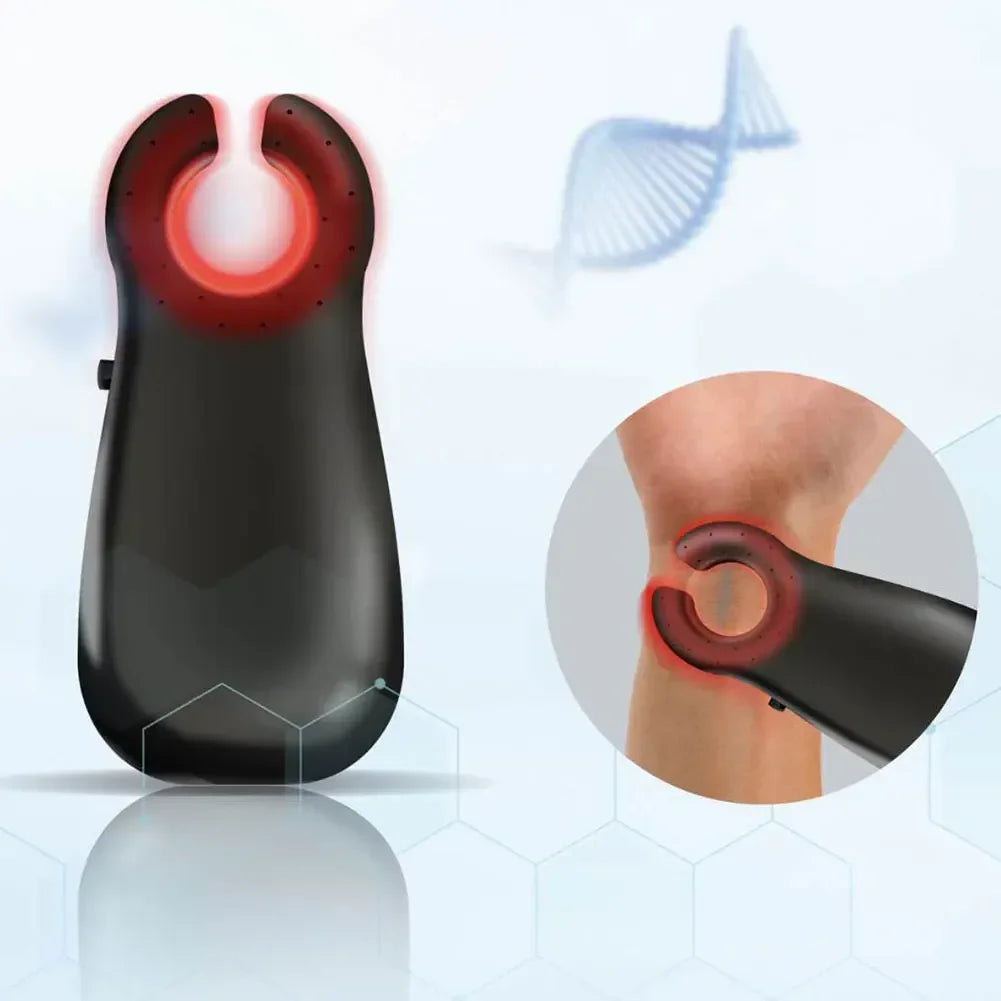
The short version. It is a rechargeable handheld light. The head is an open horseshoe lined with small red emitters. You press that ring flat on the skin, the tissue underneath lights up, and superficial veins show as darker lines against the glow. That is the entire mechanism.
The mechanism, corrected
It lights tissue from the surface. It does not project a map.
This is contact transillumination. Red light goes into the tissue and scatters; hemoglobin absorbs strongly at these wavelengths, so vessels carrying blood come back darker than the tissue around them. The ring has to be on the skin for that to happen — held above the arm it does nothing useful.
There is no camera in this device, no projector and no screen. It does not draw an image of your patient's veins onto their skin, and it does not measure or report how deep anything is. It has one button and a ring of light. We are being this specific because the earlier version of this page described a different kind of instrument altogether, and a clinician who bought expecting that would have been justifiably annoyed.

Using it
Four steps, and the open side of the ring is the part people appreciate.
Charge it
It runs on an internal rechargeable battery and comes with a mains charger. Choose the plug type for your country at the top of this page.
Press it on
Put the lit ring flat against the skin over the area you are assessing. Contact matters; a gap under the ring leaks light and washes out the picture.
Move and look
Slide it slowly. Vessels appear as darker lines inside the lit circle. Dim the room if you can — contrast improves markedly in lower ambient light.
Work through the gap
The ring is a C, not a closed circle. The open side lets you keep the light in place and still reach the site, rather than lifting the device and losing your landmark.
Read this before you rely on it
Where it works well, and where it will let you down
- Performance is not uniform across patients, and we will not pretend it is. Transillumination depends on how much light gets through tissue and back out. Melanin absorbs strongly in this part of the spectrum, and so does subcutaneous fat. The picture is best on thin, lightly pigmented tissue and degrades as pigmentation and depth increase. We hold no test data for this unit on any skin type. If your patient population skews toward deeper skin tones or higher body mass, treat it as unproven for your setting and trial it before you build it into a routine.
- It shows superficial vessels only. Anything deep is beyond what surface light can reach, and it does not distinguish a vein from an artery for you. That judgement stays with you.
- We make no claim about your success rates. Vein visualization is a real and established modality, and the published evidence on whether it improves first-attempt cannulation is genuinely mixed and varies by patient group. None of that literature concerns this particular unit. So we are describing the physics and leaving the clinical judgement where it belongs.
- Ambient light fights it. Under bright overhead clinical lighting the contrast drops. This is a property of the method, not a defect.
- It is an aid to your assessment, not a substitute for it. It is not a diagnostic instrument and nothing here is guidance for a clinical decision.
Regulatory status — stated plainly
What class this is, and what we do not hold
In the United States a battery-powered device intended to illuminate body surfaces during a medical examination is a Class I device under 21 CFR 880.6350. Devices in that class are exempt from premarket notification, so there is no 510(k) clearance number for a plain illuminator of this kind to have. The established makers in this category are FDA registered and listed, which is a different thing from cleared or approved.
Exemption from clearance is not exemption from regulation. The manufacturer and the US importer are still expected to register with FDA and list the device, and to meet labelling requirements. We do not currently hold that paperwork for this unit. We cannot name the manufacturer, we have no FDA establishment registration or device listing number for it, and no manufacturer's instructions-for-use document has reached us. We have asked for all of it and we will publish it here when it arrives.
Until then: buy this as a well-made unbranded light, not as a documented instrument, and check it against your own facility's device policy before it goes near a patient. If your procurement requires a registration and listing number on file, do not order it yet.

Infection control
There is no manufacturer-validated cleaning method for this device
This matters more than anything else on the page if the device is going to move between patients, so here is the whole of what we know.
It is not sterile and it is not single-use. We hold no manufacturer cleaning or disinfection instructions, no list of disinfectants the shell is compatible with, and no ingress protection rating. The head has small openings molded into the face around the ring, which means fluid can get inside it. Nothing we have seen tells us the housing will survive repeated wiping with a hospital-grade disinfectant, and nothing tells us it will not.
A device that touches only intact skin is normally handled as a non-critical item, which in most facilities means an intermediate- or low-level disinfectant wipe between patients. Whether that is acceptable here is a decision for your infection-control lead, not for us. If your policy requires a manufacturer-validated reprocessing method, this device does not currently come with one, and you should treat it as single-clinician equipment until it does.
Specifications, split into what we know and what we do not
Everything in the first three cards comes from the device itself or from our own photography of it. The last card is genuinely unknown to us and is on our list to obtain.
Body
Molded glossy plastic, black, hand-sized, one side button, one charge socket. Supplier lists the material as ABS.
Head
Open C-shaped ring lined with small red emitters on its inner face. Visible red light, used in contact with skin.
Power
Internal rechargeable battery with a mains charger. The charger label reads 100–240 V, 50/60 Hz in and 12.6 V / 380 mA out.
Still to obtain
Emitter wavelength, battery capacity, runtime per charge, device dimensions and weight, manufacturer identity, FDA registration and listing, IFU, cleaning method.
A note on the size figure that used to appear here. The supplier's listed 22 x 23 x 10 cm (8.7 x 9.1 x 3.9 in) is not the size of the device — the device sits inside a palm in every photograph we hold. It is almost certainly the packed carton, so we are not printing it as a device dimension. The device's own measurements are in the "not known" card until the supplier sends them.
Everything we could verify, and nothing we could not
It is a bright, well-shaped, rechargeable transillumination light with a genuinely useful open ring. That is a real thing worth owning. It is not an imaging system, and we are not going to sell it to you as one.
Mechanism described physically Device class and its limits stated Undocumented specs listed as undocumented