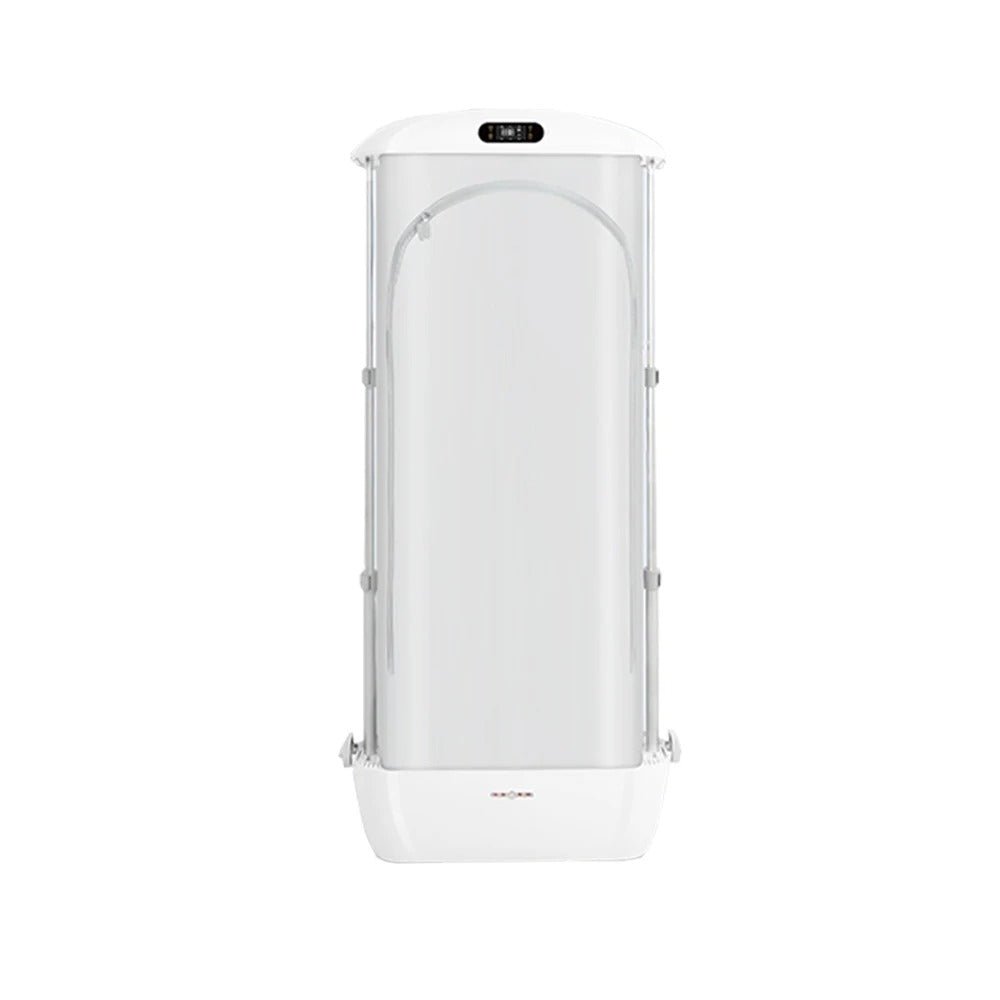
Foldable Electric Clothes Dryer - Ventless Warm-Air Drying Cabinet for Apartments
Foldable Electric Clothes Dryer - Ventless Warm-Air Drying Cabinet for Apartments
Couldn't load pickup availability
A dryer you can put away
Some homes will never have a vented dryer. There is no duct to run, no closet deep enough, and no landlord who wants to talk about it. So the laundry goes over a rack, over a chair back, over the shower rail, and three days later the room still smells like damp cotton.
This is a drying cabinet that stands up when you need it and folds away when you don't. Four telescoping poles hold a fabric cover between a molded top canopy and a shallow base tub. You hang your clothes on the rail inside, zip the front flap shut, and a blower in the base pushes warm air up through the chamber and around the fabric until it is dry.

What it actually is
It helps to be precise about this, because the category is full of things that look alike and work nothing alike. This is not a tumble dryer and it is not a steam press.
Air is the whole mechanism. There is no drum, so nothing tumbles and nothing gets beaten around. There is no vent hose, so there is nothing to route out of a window. What there is, is an enclosed chamber that holds warm moving air against your clothes for as long as you set the timer for.

Hangers, not a heap
Because everything hangs, everything comes out hanging. Shirts go straight from the rail inside to the rail in your closet without a folded stage in between, which is most of why this suits work clothes better than a rack does.
It also means spacing matters more than it does in a drum. Air has to get between the garments to do anything. Hang four things with a gap between them and it works properly; cram in eight and the middle ones stay damp.

Smoother, not pressed
Warm air on a hanging garment does relax creasing. A shirt that has been sitting screwed up in a washer drum comes out of this looking considerably better than it went in, and for a lot of everyday clothes that is the end of the story.
It is not an iron and we are not going to call it one. This listing has historically used the phrase "automatic ironing", and that word promises something the machine cannot do. Pressing needs weight and contact. Warm air has neither. What you get is a garment that hangs out smoother and softer than air drying leaves it — not a crease down a sleeve and not a collar you could cut bread with. If you want a sharp finish on a dress shirt, you will still be reaching for an iron afterwards, on a garment that is at least already warm and relaxed.

It folds down
This is the part that decides whether a thing like this earns its floor space. The poles push down, the cover gathers, and the canopy comes to rest on the base tub as one compact bundle you can slide beside a closet or under a bed.
Set-up and take-down are not instant. It is a few minutes of telescoping poles and seating the cover, each way. If you are going to run laundry every day, most people leave it standing. If you need it twice a week in winter, folding it away is the entire point.

Be realistic about time and fabric
Warm air drying is gentle, and gentle is slow. This is not a fifteen-minute machine.
- Thin things do best. Shirts, blouses, uniforms, scrubs, socks, underwear, baby clothes and light knits are what this is for.
- Heavy things take a long time. Denim, hoodies, thick sweatshirts and winter coats will dry, but you should expect to set the timer again.
- Wring or spin first. Anything still dripping should go back through a spin cycle before it goes in here.
- Air reaches the top of the chamber first. If you are drying a mixed load, put the heaviest thing where the air moves best and check it before you assume everything is done.

Using it safely
This is a mains-powered heating appliance with fabric enclosed around it, so treat it like a heater rather than like a laundry rack. Stand it on a hard, level floor with clear space on every side. Never run it inside a closed closet, under a shelf, against a curtain or with anything resting on the canopy. Keep the base clear so it can draw air. Don't run it unattended overnight or while you are out, and don't leave it where a small child or a pet can pull it over. Plug it straight into a wall outlet, not into a light-duty extension cord or a daisy chain.
When this is the wrong machine
We would rather you bought the right thing somewhere else than the wrong thing here.
- You have a vent and the space for a real dryer. Then buy a real dryer. Nothing here beats a drum on speed or capacity.
- Big family loads. This holds what fits on one rail with air between the pieces. Towels and bedding for a household is not the job.
- You want pressed shirts with no iron. See above. That is a press, not this.
- You want it to sanitize. We make no disinfection, sterilizing or antibacterial claim for this machine at all. It dries clothes.
Looking after it
- Wipe the plastic with a damp cloth. Let the cover dry fully before you fold and store it, or it will smell.
- Keep the base vents free of lint and dust.
- Extend and clamp all four poles fully before you load it. A half-seated pole is how a loaded cabinet leans.
- Unplug it when you are not using it, and don't fold it away while it is still warm.