Electric Nail Drill Set - Corded Manicure & Pedicure File with 6 Bits and 6 Sanding Bands
Electric Nail Drill Set - Corded Manicure & Pedicure File with 6 Bits and 6 Sanding Bands
Couldn't load pickup availability
A small corded file for doing your own nails at home
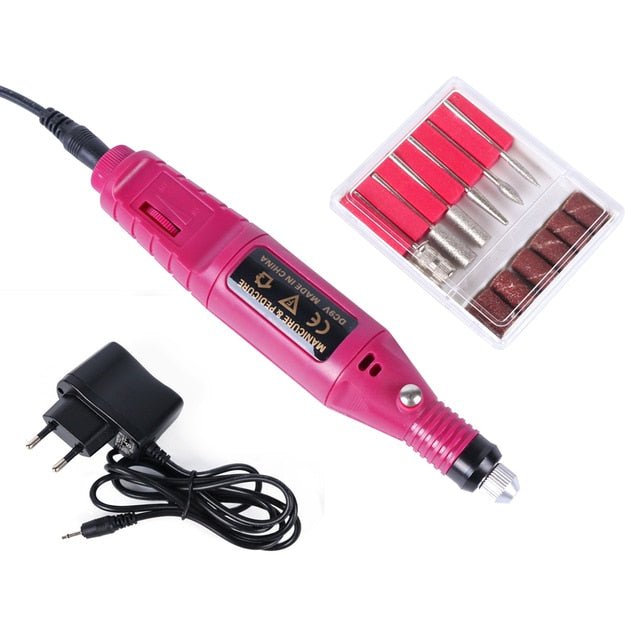
It is a pen. About as long as your hand, light enough to hold like a pencil, with a cord out of the back into a wall adapter. A slider on top takes it from stopped up to full speed, and a chrome collet at the nose grips whichever bit you have chosen.
Shaping the free edge, taking the shine off before polish, easing back a lifted gel edge, smoothing a thickened toenail, buffing a ridge flat. It is a real tool and it does real work, and it will save you a trip for the small jobs between appointments.

What this is not: a professional machine
The old copy on this page called it professional-grade and told you it would replace salon visits. We have taken both off, because they are not true and because believing them is how people get hurt.
A salon e-file is a separate brushless motor box with a corded handpiece, a foot pedal, a forward-reverse switch and a torque rating, and it costs many times this. This is a low-power handheld running on nine volts from a small wall adapter. It has the speed to smooth and shape. It does not have the torque to grind through a thick acrylic set without bogging down, and it is not built for a full working day.
One of our own reviewers puts it better than we could: "It did get the job done, however if I do continue I will purchase a higher quality drill. This drill is good for small jobs." That is the honest position. Buy it for your own nails and small jobs. If you are working on paying clients, buy a professional machine.
Exactly what is in the box
The old page said "a variety of interchangeable drill bits", which is not a package list. Here is the count.
- One handpiece - pink, corded, with the speed slider and the chrome collet chuck.
- One wall adapter and cord - in the plug type you select at checkout.
- Six drill bits, each a different shape: a knurled metal barrel that the sanding bands slide onto, a small rounded flame, a broad flat-topped cylinder, a tapered cone, a narrower flat-topped cylinder, and one fine pointed needle. The five grit-coated ones are diamond bits.
- Six sanding bands - short brown abrasive sleeves that fit the knurled barrel. These are the consumable; they wear out and you replace them.
That is the whole kit. Some of the older photographs on this listing showed large thirty-piece bit trays alongside the tool. Those trays are not part of this product and they do not ship with it. If you want more bits later they are sold separately and any standard nail-drill bit will fit.

Read this before you switch it on
A spinning abrasive against a nail makes friction, and friction makes heat. Heat is what causes almost every injury people get from these tools: a burn on the nail bed, a nail plate filed too thin, a nick to the soft skin at the base of the nail. None of that comes from the tool being bad. It comes from going too fast, pressing too hard, or holding the bit in one spot.
- Keep the bit moving. Constant light sweeps. Never park it.
- Start slow. Push the slider up gradually and stop where it is doing the work. On a natural nail you need far less speed than you think.
- Barely any pressure. Let the grit cut. If you are pushing, the bit is blunt or the speed is wrong.
- Stop the instant anything feels warm. Warmth is the warning, not the injury. Wait, then carry on.
- Stay off the skin around the nail, especially the soft cuticle fold at the base.
- Give it a rest after about twenty minutes. This is our own recommendation, not a manufacturer rating - the motor and the bit both build heat, and this is a small tool.
If you have diabetes, nerve damage or reduced feeling in your feet, or circulation problems, speak to your doctor or a podiatrist before using this on your toenails. Reduced sensation means you may not feel a burn or a cut while it is happening, and a small wound on a foot with poor circulation is not a small problem. This is standard advice for all powered foot care and we are not going to leave it out.
The speed control, and why it is the important part
The slider on the top of the body is continuously variable - it is not a two-position switch. You push it forward with your thumb, mid-grip, without putting the tool down, so you can back the speed off the moment you feel the bit start to bite too hard.
We are not publishing a maximum rpm figure for this unit, because the supplier has not given us one and guessing at a number that people will then run their nails at is not something we will do. Set it by feel, keep it at the lowest speed that is doing the job, and read the safety notes above. If a documented figure reaches us we will put it here.

Changing a bit
Hold the body, press the small chrome button on the side to lock the spindle, and twist the knurled chrome collar at the nose to loosen it. The bit slides out; the next one slides in; twist the collar back down. No key, no tools, a few seconds.
Sanding bands go on differently: they slide down over the knurled metal barrel, which is itself one of the six bits. When a band is worn smooth, pull it off and put a fresh one on.

Power, and what we can and cannot tell you about it
The handpiece itself is a low-voltage 9 V DC tool. It does not touch mains voltage - the wall adapter does that, and it steps the mains down before anything reaches your hand. The adapter is region-specific, which is what the Plug Region option at the top of this page selects: the US option ships with a flat-blade North American adapter, and the EU, UK and AU options ship with their own molded plug bodies. It is a different adapter, not a travel pin adapter clipped onto a foreign one.
Now the part most listings leave out. The tool carries a CE mark and an indoor-use symbol, and nothing else. CE is a manufacturer's own declaration for the European market. We do not hold a UL, ETL or any other North American safety listing for this unit or its adapter, and we are not going to imply one. If a third-party safety certification is what you need, this is not the product to buy.
Practical care follows from that: indoor use only, keep it away from water and damp hands, do not run it with a damaged cord, and unplug it at the wall when you are done rather than leaving the adapter live.

The details
Who should buy it, and who should not
Buy it if you do your own nails and want to stop fighting a glass file - to shape an edge, buff a ridge, take the shine off before gel, tidy a thickened toenail, or keep things neat between appointments. At this price it is a genuinely useful little tool.
Do not buy it as a salon machine, do not buy it to work on other people for money, and do not buy it expecting to grind a full acrylic set off in one sitting. And if you have diabetes, neuropathy or circulation trouble, talk to a clinician before it goes anywhere near your feet.