Cordless Drain Auger - 12V Battery Power Drain Snake with 5 ft Steel Cable, for Toilets, Sinks, Tubs and Showers
Cordless Drain Auger - 12V Battery Power Drain Snake with 5 ft Steel Cable, for Toilets, Sinks, Tubs and Showers
Couldn't load pickup availability
Cordless drain auger · 12V battery · 5 ft cable
Five feet of steel cable, spun by a battery drill
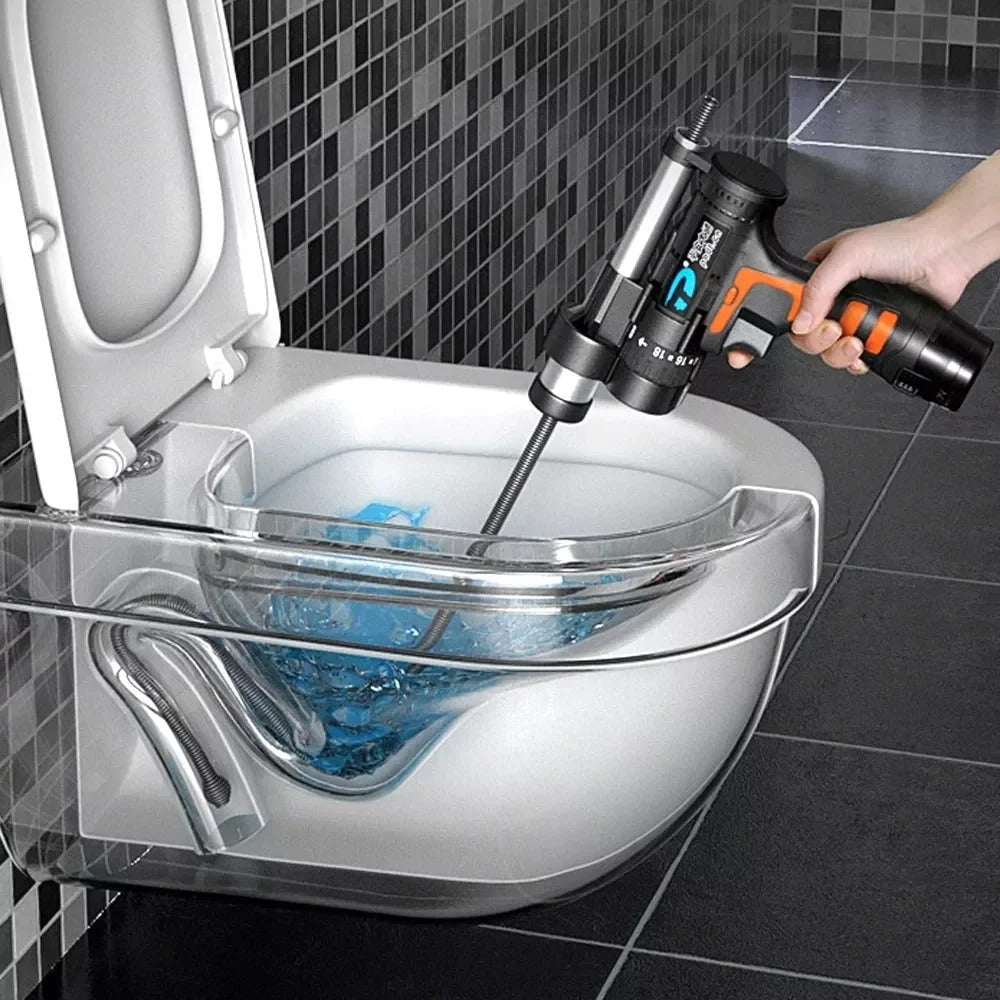
That sentence is the whole product. It is a pistol-grip cordless tool with a 12V lithium battery in the handle, an auger head on the nose, and a single 5 ft (1.5 m) wound-steel spring cable that feeds out of it. Squeeze the trigger and the cable turns and drives forward. There is nothing else in the box that changes what it can reach.
We are leading with the cable length because on a drain auger it is not a footnote, it is the specification that decides every job the tool can and cannot do. This page previously described it as a tool for outdoor drains. Five feet does not reach an outdoor drain, and that claim has been removed.
Reach
What five feet actually gets to
A drain auger is measured by how far past the opening it can put a spinning cutting tip. Five feet is a fixture-level tool: it clears the trap and the short run of pipe immediately behind it, which is where the great majority of household blockages sit. Past that it simply runs out of cable.
Toilet traps
The S-bend inside the china, and the short stretch of pipe just behind it. This is the clog that stops a toilet flushing, and it is the one this tool is built for.
Sink, basin and tub traps
Fed in through the drain opening, five feet reaches the P-trap under the fixture and on into the branch pipe behind it — hair, grease and soap build-up.
Outdoor and main lines
Yard drains, gully traps and a blocked main sewer sit tens of feet from any opening you can get to. This tool cannot reach them and will not clear them. Those jobs need a long-cable drum machine.
The 5 ft figure is the supplier's own stated cable length and matches the carton spec of 1.5 m. It is the length of the cable, not the depth of the pipe run it can travel — a cable turning through a tight trap uses some of its length getting round the bend.
Power
It runs on a battery, not on a wall socket
12V lithium pack in the grip
The “12V” on this listing is the battery, not a mains supply. A rechargeable pack slides into the base of the handle, and a small plug-in charger is included to refill it. Nothing is plugged into the wall while you are working.
That matters in a bathroom
You are using a powered tool over standing water on a hard wet floor. A cordless tool means no mains lead trailing across that floor and no extension cable near the fixture — which is the single most sensible thing about this design. Charge it somewhere dry, then carry it to the job.
What we do not know about it
We hold no UL, ETL or CSA listing for this tool and no test report from the supplier. We are not going to imply a safety certification by staying quiet about it: as far as our documentation goes, this is an uncertified imported power tool. If that matters to you — and for a powered tool used around water it is a fair thing to care about — buy a listed one instead.
One trigger, one collar
A variable trigger runs the motor, and a rotating collar behind the head sets how much torque the tool will apply before it slips — the same adjustable clutch you find on a cordless drill. Turn it down when you are working in china or older pipe.
The cable locks and releases at the head
A clamp in the head grips the cable so it turns with the motor, and releases it so you can feed more out or draw it back by hand. That is the “automatic clamping” on the listing: a mechanical grip on the cable, nothing more clever than that.
One hand on the tool
It is light enough and balanced enough to run with one hand on the grip, which leaves your other hand free to guide the cable into the opening. That is genuinely useful when you are kneeling next to a toilet. It is not a reason to leave it running unattended, and we have removed the line on this page that suggested it was.
Before you use it
Read this bit, it is short
This is a steel cable spinning at drill speed inside a fixture you probably do not want to replace. Almost everything that goes wrong with an auger goes wrong in the first ten seconds.
- Wear eye protection and gloves. A cable that catches can whip back, and whatever it brings up comes up fast. Gloves also stop the turning spring grabbing at your fingers.
- Never auger a drain that has chemical drain opener sitting in it. If you have poured a caustic or acid product down and it has not cleared, the standing liquid is still caustic. A spinning cable throws it back at your face and hands. Flush it through and let it clear first, or leave the job alone.
- Steel on porcelain leaves marks. A toilet bowl is glazed vitreous china and the cable can scratch or chip it, especially at the lip where it enters. Feed the cable in by hand until it is past the visible bowl, keep it off the glaze, and start the motor after it is in the trapway.
- Go carefully in older or plastic pipe. Thin-wall PVC and ABS, old clay, and corroded cast iron can all be damaged by a powered cable, and a cable that finds a joint or a crack can make it worse. Turn the clutch down, let the tool feed itself, and stop if it stops advancing.
- Do not force it. If the cable stops moving forward, back it off and try again rather than leaning on it. Forcing a cable is how it kinks, and a kinked spring is finished.
- Keep it out of children's reach and off a charger you cannot see. It is a lithium tool. Charge it on a hard surface in a dry room.
How you use it
Three steps, and one of them is stopping
Feed the cable in by hand until the tip is past the bowl or the drain opening and into the trap. Keep the motor off while any part of the cable is against visible glaze.
Squeeze the trigger and let the tool advance itself. Keep light forward pressure only. When the cable breaks through you will feel it go slack and start turning freely.
Reverse it out slowly, run water, and check the fixture drains. If five feet has gone in and nothing has changed, the blockage is further down the line than this tool goes — stop, and get a longer machine on it.
What came off this page
The claims we removed, and why
This listing carried a set of statements we could not stand behind. Rather than soften them, we deleted them. You are entitled to know what changed before you buy.
- Outdoor drains. The page said the cable clears outdoor drains alongside toilets, sinks and showers. It cannot; five feet does not get near one. That fixture was struck from the list.
- Three customer quotes. Three testimonials appeared here, one of them putting a specific dollar figure on money saved. None could be tied to a real order and the saving was not something we could evidence. All three were deleted rather than reworded, and we have not replaced them with anything.
- A buyer count. A heading announced a specific number of people who had bought the tool. The number was not real. It is gone.
- A price comparison. The opening paragraph quoted a specific dollar figure for a plumber's call-out. We have no source for that figure and call-out rates vary enormously by trade, region and hour, so it has been removed rather than adjusted.
- A line telling you the tool needs no supervision. It said this was designed for solo use with no second pair of hands and nothing to watch. One-handed operation is real and we have kept that. Telling somebody a spinning steel cable does not need watching is not advice we are willing to leave on the page.
- Three performance claims. Assertions about how fast the motor gets through a blockage, how the head handles bends, and how long the tool lasts in repeated use. We have no supplier test data behind any of them, so none of them are stated here as fact.
- A hotlinked image. One picture in the old description was loaded live from a third-party marketplace, meaning that site could have swapped it for anything at any time and it would have appeared on this page. It has been removed.
Specification
What we can actually confirm
Cable diameter is not stated by our supplier and we are not going to guess at it. Motor speed, torque, battery capacity and runtime are likewise undocumented, so you will not find them quoted anywhere on this page. Weight and carton size are the shipping figures from the supplier's specification, not a weighed unit.
In the box
What ships
- One cordless drain auger with a rechargeable battery pack fitted in the grip.
- One 5 ft steel spring cable. One cable, one length. There are no alternative cables or cutting heads in the box.
- One plug-in charger for the battery.
- A printed instruction sheet.
Gloves and eye protection are not included and you should wear both. Our supplier's marketing video ends on a picture of the tool laid out with work gloves, a hook and a second cable; that is not the package we ship, and we are flagging it here rather than letting the picture do the talking.
The right tool for a trap, and not for a sewer
If your toilet, basin, tub or shower has stopped draining, this puts a powered cable into the trap for you and does the arm-work. If the blockage is further out than that — and a whole-house backup usually is — nothing here will reach it, and we would rather you knew that before you ordered than after.
Share