Elderly Safety Bed Guard Rail - Adjustable Height and Fall Prevention Bed Rails for Adults
Elderly Safety Bed Guard Rail - Adjustable Height and Fall Prevention Bed Rails for Adults
Couldn't load pickup availability
Something solid to pull yourself up on
Getting out of bed is a strange movement to lose. You are lying flat, low down, half asleep, and the only things in reach are a mattress that sinks and a nightstand that slides. Most people who struggle with it are not weak. They just have nothing to hold.
This puts a padded handle at the edge of the mattress, at about the height of your hip when you stand beside the bed. You take hold of it to roll onto your side, to push up to sitting, and again to stand. The work comes from your arm as well as your legs, and you are pulling against something that reaches all the way down to the floor.
What it is, and what it is not
The name says "guard rail," and that is the phrase the whole category is sold under, so it is worth being exact about the shape of the thing.
This is an assist rail. One padded arch, about 13.8 in (35 cm) across — roughly the length of your forearm. It sits at one spot along the side of the bed, where your hand lands when you sit up. It is a handhold.
It is not a full-length barrier. It does not run the length of the mattress, and it is not a hospital side rail. If what you actually need is something that stops a person rolling out along the whole side of the bed, or something to manage a person who gets up confused at night, this is not that product and we would rather tell you now.
The legs are the point
A lot of bedside handles are held up by nothing but the weight of the mattress sitting on a plate. This one has that plate too, but it also has two adjustable legs that stand on the floor, on molded rubber feet.
That matters for two reasons. Your weight goes into the floor instead of into the side of the mattress, so the rail does not lever the mattress up as you push on it. And the rail is far less able to shift out of position, which is the thing that has to be right on any product of this kind.
The manufacturer rates it to 300 lb (136 kg). Both the arch and the legs adjust, independently, so you can set the grip height and the leg length to your own bed.
Will it fit your bed? Measure one thing
Take a tape measure to the bed it is for, before you order. Bed width is irrelevant — twin, full, queen or king makes no difference. What matters is the height underneath.
- Measure from the floor to the underside of your mattress. That distance has to land between 10.8 in and 19.7 in (27.5–50 cm). That is the full range the legs extend to. Below it the legs will not shorten enough; above it they will not reach the floor, and a leg that does not reach the floor is not doing its job.
- No mattress topper, no soft pad, no memory-foam layer on top. A compressible top layer lets the mattress sink away from the rail under load and opens a gap beside it.
- Not on a water bed, an air bed, a bunk bed or an adjustable bed that raises and lowers. A frame that moves cannot keep a fixed relationship with a rail that does not.
If your bed sits on a low platform or a divan base with drawers, measure before anything else. That is the usual reason one of these comes back.
Fitting it, and the strap
It goes together in a few minutes without tools. The flat frame slides under the mattress from the side, the upright and arch pin into it, and the two legs drop down and lock at the height you set.
Then there is the strap, and the strap is not an optional extra. A long webbing belt with a side-release buckle comes in the box. It passes around the bed base and pulls the under-mattress frame tight to the bed so the rail cannot creep, tip or walk out of place. Fit it, pull it tight, and check it again every few weeks. Almost everything that goes wrong with a bedside rail starts with the rail moving.
Using it safely
This is a category with a real safety history, and the honest version is short.
The hazard is a gap. Any space that opens up between the rail and the side of the mattress is the thing to watch, because a head, a neck or an arm can end up in it. No gap dimension is published for this rail, and we are not going to invent one. The instruction is simpler than a number anyway: there should not be a gap. The rail should sit tight against the mattress, and it should still be tight the next time you look.
- Set it up so the rail is flush against the mattress, with the strap tight. Re-check after you change the sheets, turn the mattress, or move the bed.
- Keep it clear of the headboard and footboard rather than tucked up against them.
- Press down hard on the arch before anyone leans on it, every time you have moved it.
It is not for everyone. The US Food and Drug Administration's guidance for adult portable bed rails is direct about this: they are not suitable for people who are confused, restless, or without reliable muscle control, and they carry a heightened risk for anyone with cognitive impairment from dementia, Alzheimer's, Parkinson's or stroke. It is also not for children, and it is not a restraint. If the person it is for is at risk of getting up disoriented at night, talk to their doctor or occupational therapist before buying any bed rail, and ask about the alternatives — a lower bed, a floor mat, a roll guard.
And it does not replace someone checking in. A rail is a handhold, not supervision.
The pouch
A plain fabric pouch hangs from the frame, on the outside, about the size of a paperback laid flat. Glasses, phone, remote, a book. It is a small thing that stops the 3 a.m. reach across to a nightstand, which is its own way of ending up on the floor.
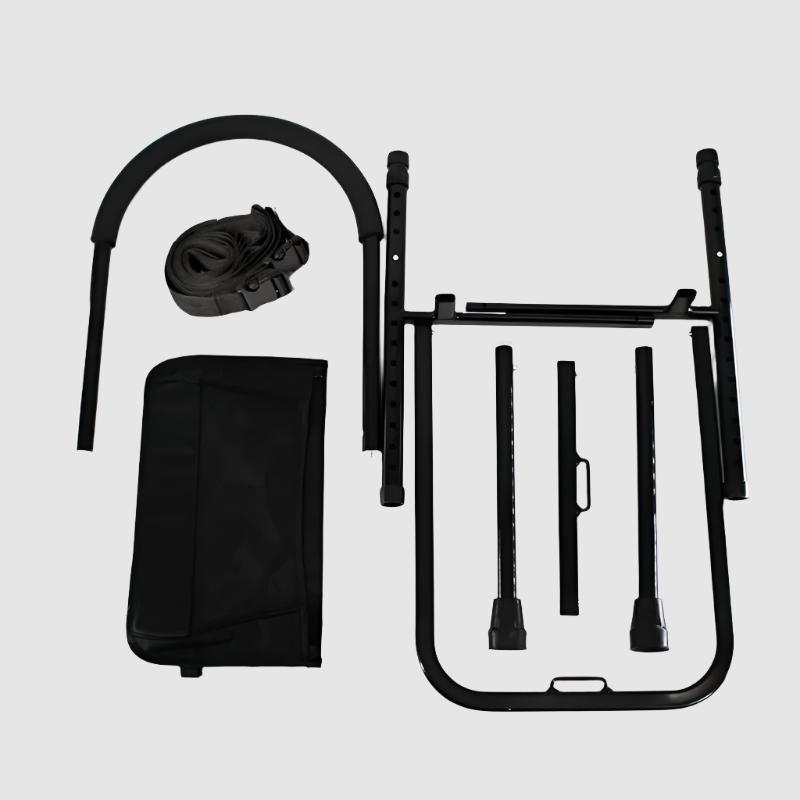
What comes in the box
- The foam-covered handle arch
- The upright frame, with the height adjustment
- The flat under-mattress frame
- Two telescoping support legs with rubber feet
- The fabric storage pouch
- The retention strap and buckle
No tools are needed to put it together.
Specifications
- Handle width
- 13.8 in (35 cm) — the span of the arch
- Handle height
- 20.5–23.6 in (52–60 cm), measured up from the frame that sits under the mattress. Subtract your mattress thickness to find how far it stands above the sleeping surface
- Leg range
- 10.8–19.7 in (27.5–50 cm), floor to the underside of the mattress
- Overall height
- 31.9–43.3 in (81–110 cm), floor to the top of the arch
- Weight limit
- 300 lb (136 kg), as rated by the manufacturer
- Product weight
- 5.7 lb (2.6 kg)
- Frame
- Aluminum alloy, as specified by the manufacturer
- Handle
- Foam sleeve over the metal arch
- Assembly
- Tool-free
- Fits
- Any bed width. Fit is set by the height under the bed, not the size of the bed
Share