Car Glass Oil Film Cleaner - Glass Polishing Degreaser Cleaner Oil Film Water Spot Remover For Bathroom, Window Glass and Windshield Cleaner
Car Glass Oil Film Cleaner - Glass Polishing Degreaser Cleaner Oil Film Water Spot Remover For Bathroom, Window Glass and Windshield Cleaner
Couldn't load pickup availability
Glass cleaning cream
A cream you rub on with a sponge, not a spray you mist on.
Car glass picks up a thin, greasy haze over time — road film, exhaust residue, wiper rubber and mineral deposits left behind when hard water dries on the surface. That haze is what turns oncoming headlights into a starburst and what makes a windshield look dirty five seconds after the wipers pass.
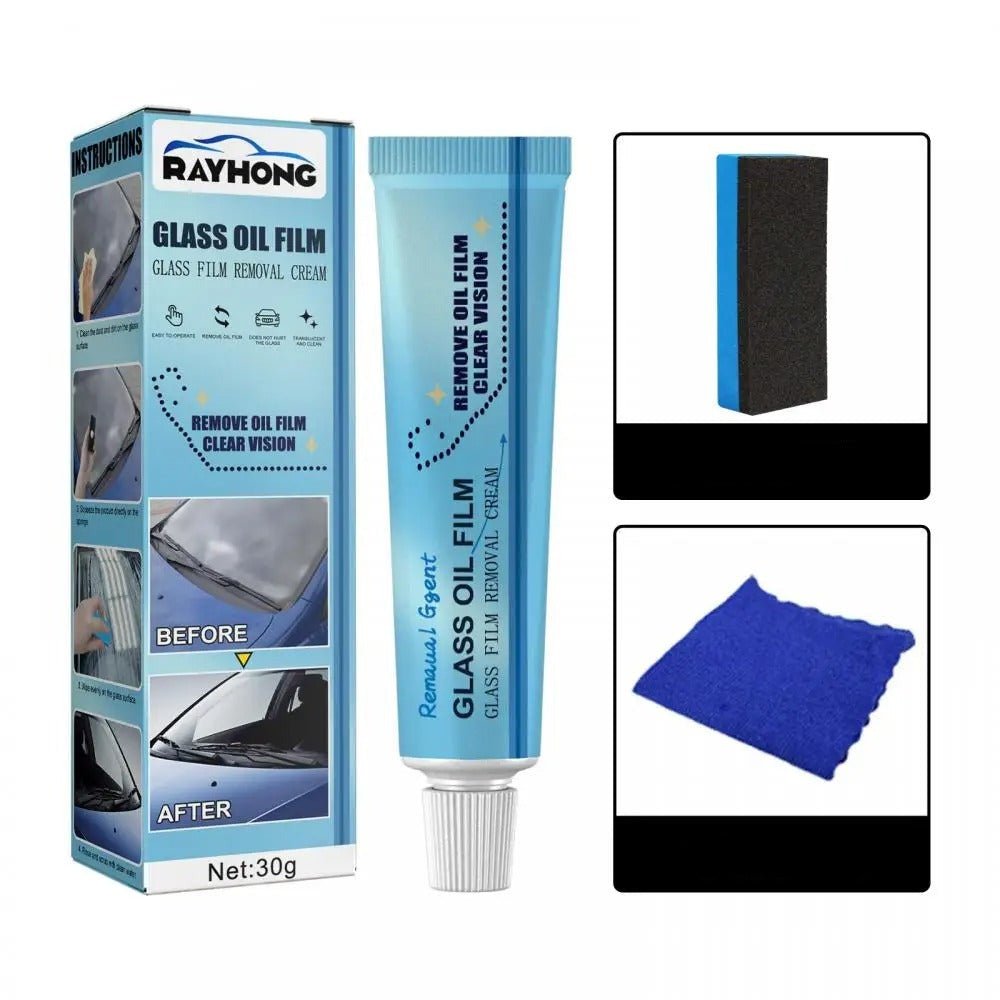
This is a 30 g tube of cleaning cream for that job. You squeeze it onto the foam block that comes with it, work it over wet glass, then rinse it off and dry with the cloth. It is a hand-applied cream, not a washer-bottle additive and not a trigger spray.
What arrives
Three pieces in a small carton.
- One 30 g tube of glass cleaning cream. The tube measures 4.21 in (10.7 cm) tall and 1.14 in (2.9 cm) across.
- One foam applicator block. 2.75 × 1.18 × 0.66 in (7 × 3 × 1.7 cm), with a backing pad so you are not pressing on the foam with bare fingers.
- One cloth. 7.87 × 7.87 in (20 × 20 cm), for the final dry-off.
Dimensions above are taken from the manufacturer's own dimensioned packaging diagram. The retail carton measures 4.29 × 1.81 × 1.22 in (10.9 × 4.6 × 3.1 cm).
How to use it
Four steps, and the rinse is not optional.
Rinse the glass with clean water first, so any grit is floated off rather than dragged across the surface.
Squeeze a small amount of cream onto the damp foam block.
Work it over the glass in overlapping passes, keeping the surface wet as you go.
Rinse the glass thoroughly with clean water, then dry it with the cloth.
Do not put this product in your windshield washer reservoir. It is a cream meant to be applied by hand with the sponge; it is not formulated as a washer fluid and does not belong in the washer system.
Before you start
Where to test first.
- Test a small, hidden area before doing a whole panel. Glass varies, and so does whatever is already on it.
- Treat exterior glass, not film. Aftermarket window tint is almost always applied to the inside of the glass, and so are most anti-glare films. We do not recommend using this cream on tinted or filmed surfaces, on hydrophobic or ceramic glass coatings, or on any plastic headlight lens, without testing an out-of-sight corner first.
- Keep it off paint and trim. Rinse any overspill promptly rather than letting it dry.
- Handle it like any cleaning chemical. Avoid contact with eyes, wash your hands afterwards, keep it out of reach of children, and store it closed and cool.
Straight answer
What we are not telling you.
We are not publishing an ingredient list for this product, because the documentation we have been able to obtain from the manufacturer's own channels does not agree with itself. Until we have a single ingredient statement we can stand behind, we are not going to print one, and we are not going to make claims about what the formula is made of or how gentle it is.
So this page describes what the product is, what is in the box, and how it is applied — and stops there. If you want a glass cleaner with a published, verifiable formulation, buy one that has it.
Share