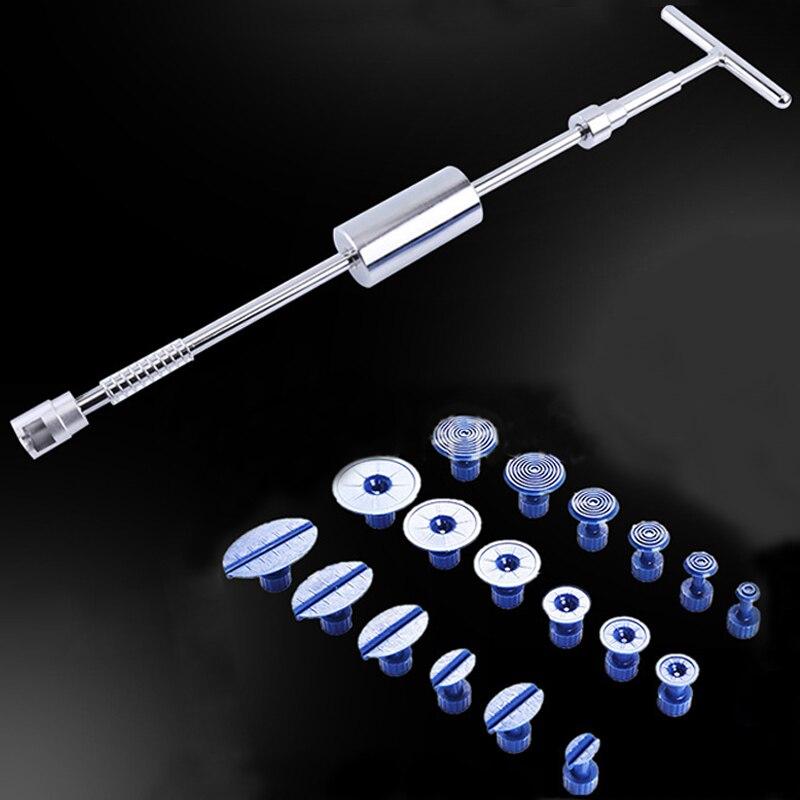
Paintless Dent Puller Kit - T-Bar Slide Hammer with Glue Tabs for Shallow Car Dents
Paintless Dent Puller Kit - T-Bar Slide Hammer with Glue Tabs for Shallow Car Dents
Couldn't load pickup availability
The method the dent shops actually use
This is a glue puller. You hot-glue a plastic tab into the low point of a dent, screw the steel puller onto the tab, and pull the metal back out from the outside — no drilling, no sanding, no filler, no repainting. It is the same basic technique a paintless dent repair technician reaches for when a dent is shallow and the back of the panel is hard to reach.
It is genuinely satisfying when it works. It is also not magic, and the rest of this page is mostly about telling you which of those two you are looking at, because that is the difference between money well spent and a tool in a drawer.
What is in your hands
Be honest about your dent first
Glue pulling has a narrow, well-understood sweet spot. Standing in front of your car for thirty seconds now will tell you more than any review will.
Where it earns its money
- Shallow, rounded dents — the saucer shape, not the crease
- Door dings and shopping-cart knocks in the middle of a flat panel
- Soft hail dimples on a roof, hood or trunk lid
- Dents where the paint is completely intact and unbroken
- Places you cannot reach from behind — that is the whole point of pulling from the front
Where it will disappoint you
- Sharp creases and folded metal — a puller cannot unfold a crease
- Dents on a panel edge, a body line, or over a brace, where the metal is stiff
- Anywhere the paint is already cracked, chipped or scratched through
- Plastic bumper covers, which flex rather than hold a pull
- Deep, hard impact damage — that is a body shop job, and pulling at it can make it worse
About paint — read this before you buy
This listing used to say the tool causes no damage to paint or surface finish. We have removed that, because it is not something anyone can promise about glue pulling. The method works by bonding hot-melt adhesive to your clear coat and then pulling hard on it. On sound factory paint that normally releases cleanly. On a panel that has been resprayed, on aging or lifting clear coat, or right at the edge of a panel, the glue can take paint with it. One of our own reviewers reports exactly that at the edge of a wheel well.
Reduce the risk: work on intact factory paint, stay away from panel edges, warm the panel gently before you glue, and release the tab by warming it rather than levering it off. If your car has been repainted, or you cannot afford a paint chip on this panel, test on a hidden area first or leave this one to a professional.
How long it really takes
The old version of this page said dents come out in under thirty minutes. Some do. A small, soft door ding can lift in a handful of pulls. But a larger dent is a patient, repetitive process — glue, pull, reheat, reposition, pull again — and our own reviewers describe spending a couple of hours on a big one and getting most, not all, of it out.
Set your expectations at "a lot better, from most angles" rather than "invisible". A faint shadow or a slight waviness that shows in a low reflection is a normal, common outcome, and it is still the difference between a car that looks knocked about and one that does not.
The glue gun question
This tool works by hot-melt adhesive, and no glue gun and no glue sticks appear anywhere in the manufacturer's photography of this kit. We do not hold a packing list that settles it either way, so please plan on supplying your own standard hot-melt glue gun and sticks. It is an inexpensive item and most households already have one. We would rather tell you now than have it arrive and surprise you.
Using it without hurting yourself or the car
- Clean and dry the panel first. Glue will not hold on wax, road film or a cold wet surface.
- Warm the metal slightly. A hair dryer is enough. Cold steel is the most common reason a tab lets go.
- Start at the edge of the dent, not the middle, and work inward in small pulls.
- Do not over-pull. It is easy to pull a dent past flat into a high spot, which is harder to fix than the dent was.
- Mind the slide weight. It runs freely on the shaft and it will catch a hand that is in the way. Keep your free hand clear of the stop.
- Release the tab with heat, then lift the remaining glue with a plastic scraper. Never a metal blade — that is how you scratch paint you had just saved.
Who should not buy this
- Anyone wanting a guaranteed invisible repair. That is a body shop, and it costs what it costs.
- Anyone with a creased or sharp dent. The tool is the wrong shape of solution.
- Anyone unwilling to risk a paint chip on a repainted or older panel.
- Anyone who wants it done in one pull. Patience is genuinely part of the technique.
If none of that put you off, you are exactly the person this tool is for — and you are about to find out why the dent shops charge what they do for something that looks this simple.
Share