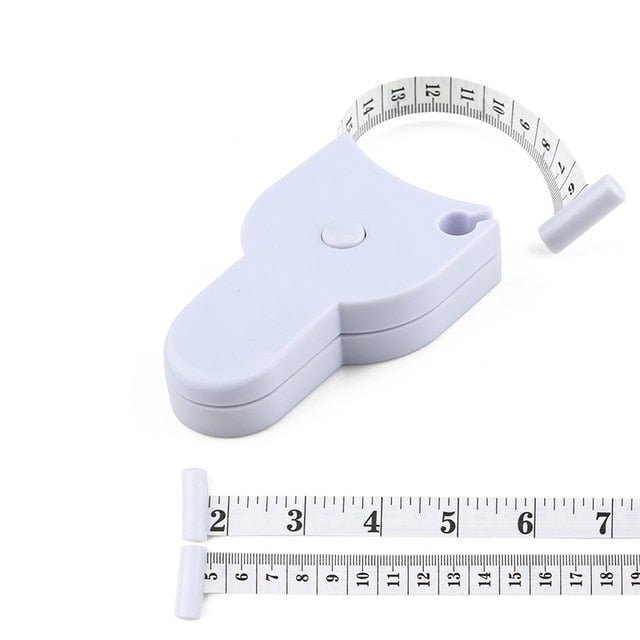
Automatic Retractable Body Tape Measure - Self-Locking Measuring Tape for Waist, Hips, Bust, Arms & Thighs
Automatic Retractable Body Tape Measure - Self-Locking Measuring Tape for Waist, Hips, Bust, Arms & Thighs
Couldn't load pickup availability
Body tape measure
A tape that holds its own loop, so you can measure yourself
A loose tailor's tape needs two hands and a helper. This one does not. The tape pulls out of a flat plastic case that sits inside your palm, and the short peg on the free end drops into a socket on the case's shoulder. That closes the tape into a ring that keeps its shape on its own — around a waist, a thigh, an upper arm — while you draw it snug, look down and read the number.
When you are done, one press of the round button on the front winds the tape back in. Nothing to roll up and nothing to lose.
How it is used
Pull and hook
Draw out roughly the length you need, bring the tape around, and press the peg on the end into the socket hole on the shoulder of the case.
Snug and read
Pull the free end until the ring is level and just firm against the skin — firm enough not to slide, not tight enough to dent. Read the number where the tape meets the case.
Press to rewind
Press the round button on the front of the case and the tape winds itself back inside.
The peg is what makes solo measuring work. It is also the part to be gentle with: seat it in the socket rather than forcing it, and let the tape rewind under the button rather than pulling it back by hand.
Both scales, on the two faces of one tape
The tape is printed on both sides. Turn it over rather than converting.
Neither face starts at zero. The inch face begins at 2 and the metric face begins at 5, because the body of the case forms part of the ring and the printed scale already allows for it — the supplier's own detail photograph marks that section of the case as 5 cm. The number at the case is your measurement; you do not add anything to it. If you would rather be certain before you trust it, close the loop once around something whose size you already know and check that the two agree.
The 59 in figure is the one stated in our own product video for this item. It is the same tape that most sellers list as a 60 in (150 cm) tape; 150 cm is 59.06 in, so we quote the shorter, printed figure rather than the rounded one.
Read this first — we have corrected this page
Four things this page used to say that we could not stand behind
The starting figure was converted wrongly. An earlier version of this page paired the 2 in start with a metric figure that does not match it. Two inches is 5.08 cm, and 5 is the number actually printed at the start of the metric face. Corrected.
The tape material was described as a specific fiber. We have no supplier documentation for what the tape or the case are made of, so we no longer name a material. Listings for lookalike tapes on the marketplaces disagree with each other on this point, which is exactly why we are not repeating any of them. It is a flexible printed ribbon in a rigid plastic case; that is as far as we can honestly go.
The page promised a level of accuracy. No accuracy class and no tolerance is published for this tape by anyone. We have taken the accuracy language out. What we will say is what the design does: the locking peg holds the loop at the same shape every time, and a measurement you take the same way twice is the one worth comparing.
The page described a handle. There is no handle on this item. It is a flat, smooth case with a button on the front and a socket in the shoulder.
Three images have also been taken out of this description. Two of them were being loaded from other retailers' servers rather than ours, and carried those retailers' own marketing text burned into the picture, including an environmental claim we cannot support. The third was a supplier collage whose panels showed stock photographs of other people's tape measures.
What it will not do
- It does not measure body composition. It reports a circumference in inches or centimeters. It says nothing about body fat, muscle or anything under the skin, and it is not a caliper.
- It is not a medical or clinical instrument. No accuracy class or tolerance is published for it. Do not use it where a clinical measurement is required, and do not use a spring-loaded tape on an infant.
- It will not change a number on its own. Some people use one of these to track how their measurements move over weeks or months. The tape records a figure; it does not cause one.
- It is not a builder's tape. The ribbon is soft and it will not stand out straight across a room. It is made to go around things.
- It does not lock at a reading. The peg locks the loop closed; it does not freeze the tape at a number. Read it while the loop is on.
- It is one tape, not a set. One tape measure ships per order, in the color you choose.
Measuring yourself so the numbers are worth comparing
Consistency beats precision. The same tape, taken the same way, at the same time of day, will tell you more about change than a more accurate measurement taken differently each time.
- Measure over bare skin or a single thin layer, never over a sweater or a waistband.
- Keep the ring level all the way round. A tape that rides up at the back reads short. A mirror is useful for this even though you do not need a second pair of hands.
- Breathe out normally and do not hold it when you take a waist or chest measurement.
- Snug, not tight. Firm enough that the tape does not slide, loose enough that it does not press a line into the skin.
- Write down where you measured — narrowest part of the waist, widest part of the hips, mid-point of the upper arm — and use the same landmark next time.
In the box
- One retractable body tape measure, in black or off-white. That is the entire contents.
No second tape, no calipers, no body-fat chart, no measurement log, no pouch and no batteries — there is nothing electrical in it. The white version photographs as a soft off-white rather than a bright white.
Share