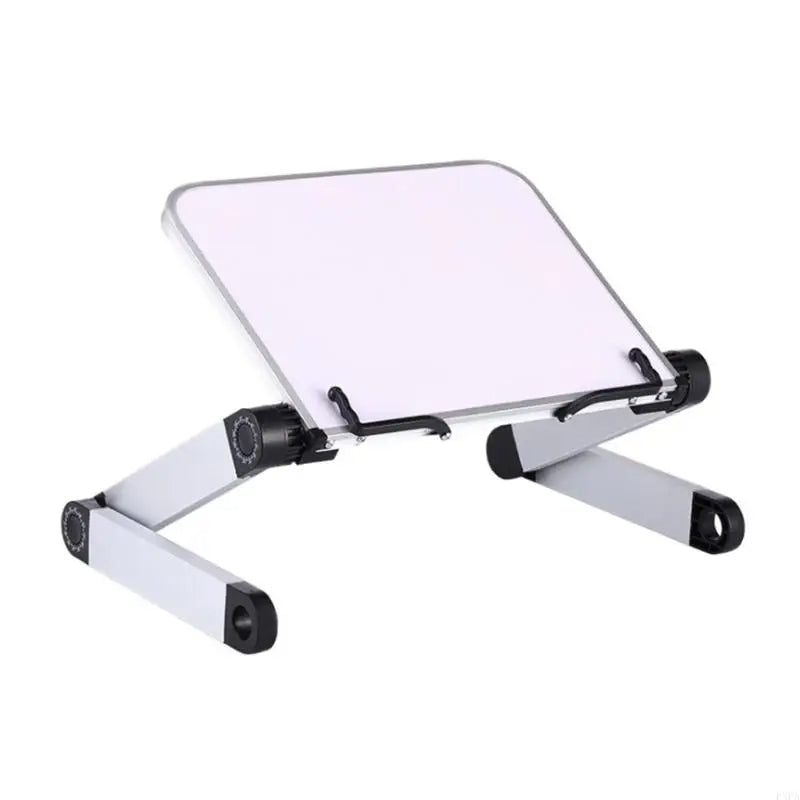
Adjustable Book Stand - Aluminum Folding Reading Holder with Page Arms for Study, Cookbooks and Tablets
Adjustable Book Stand - Aluminum Folding Reading Holder with Page Arms for Study, Cookbooks and Tablets
Couldn't load pickup availability
Adjustable reading stand
It brings the page up to you, instead of you down to the page
A book flat on a desk sits about fourteen inches below your eyeline, and your neck spends the whole session holding your head out over it. This is an aluminum tray on two jointed legs that lifts the page and tilts it toward you, so you can sit up straight and still read comfortably.
Every joint is a toothed dial rather than a friction pivot, so once you have set an angle it holds it. Both hands come free, which matters more than it sounds: you can take notes, type, chop an onion or drink your coffee without losing your place or fighting a book that wants to close itself.
The measurements that actually decide this
Tray and height figures are from the manufacturer's dimension drawing. The 70 mm book thickness is the supplier's own figure and we have not measured it ourselves, so treat it as a guide near the limit rather than a guarantee.
What "adjustable" means here, precisely
There are four toothed dials: one where each leg meets the tray, and one at each leg's own mid-joint. That is what gives you two independent controls.
- Tilt. The tray swings from nearly flat, which suits writing and a cookbook you glance down at, through to steeply upright for reading at eye level.
- Height. The legs fold and extend to put the tray anywhere from 1.6 in (4 cm) off the desk — barely more than a tilted rest — up to 10.2 in (26 cm), which is where the page starts meeting your eyeline.
- It does not swivel. The hinges are toothed through a full circle of positions, but the stand does not rotate on its base. If you want to turn the page toward someone else, you turn the whole stand.
Holding the page down is the part most stands get wrong
Two slim steel arms swing up from a narrow ledge along the tray's bottom edge. The ledge takes the weight of the spine; the arms hook over the outer edge of each page and hold it flat. Nothing clamps the spine, so nothing cracks it.
Set the book's lower edge into the ledge and let the spine settle.
Swing an arm over each page so it sits just inside the outer margin.
Lift an arm with one finger to turn the page, then drop it back.
The arms and the ledge are fixed to the tray. There is nothing loose in the box to lose.
Where it earns its desk space
A textbook you are working through rather than reading. A cookbook that needs to stay open and out of the splash zone. A tablet you want propped at a real angle instead of lying flat. Sheet music. A recipe on a laptop screen you keep having to wake up. Anything you need to look at repeatedly while your hands are busy with something else.
When you are finished, both legs fold in against the tray and the whole thing goes flat — a slim aluminum slab that slides into a drawer, a shelf gap or the back of a bag.
Sit up. Read anyway.
The whole point is that you stop choosing between a comfortable neck and a readable page. Set it once at your desk and you will notice how rarely you go back to reading with your chin on your chest.
Share