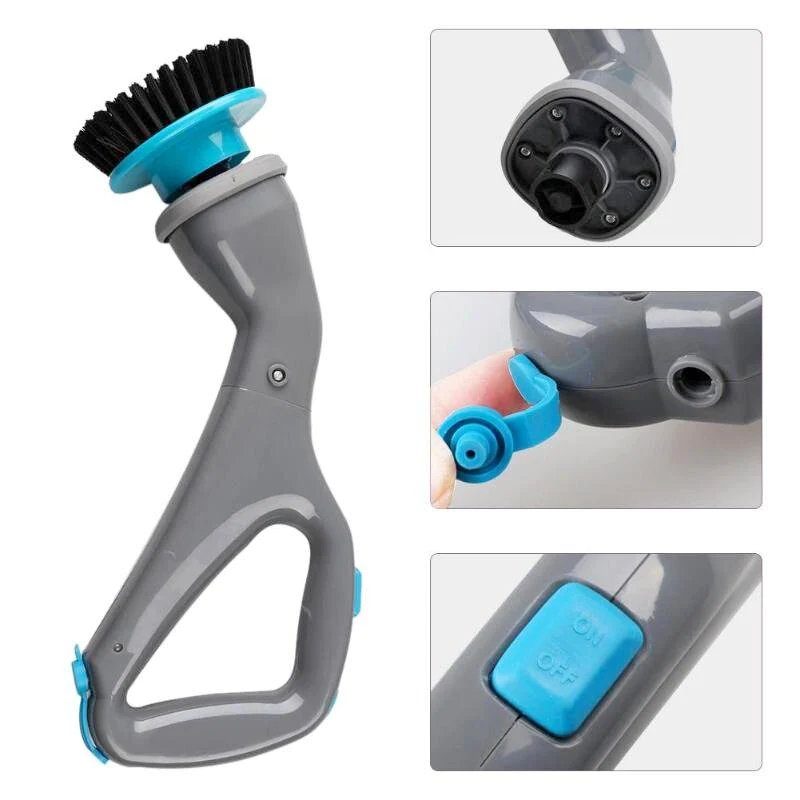
Cordless Electric Spin Scrubber — Handheld Power Cleaning Brush with Three Interchangeable Heads
Cordless Electric Spin Scrubber — Handheld Power Cleaning Brush with Three Interchangeable Heads
Couldn't load pickup availability
Cordless Handheld Spin Scrubber
A motor does the scrubbing, your arm just steers
This is a one-handed, battery-powered brush. You hold it against a surface and a motor spins the head; you supply the direction and a little pressure, and the tool supplies the repetition. That is the entire proposition, and it is the reason people buy one.
It is meant for the jobs where the scrubbing is boring rather than difficult: shower grout, the ring around a tub, a stovetop, a scorched sheet pan, wheel rims, a garden chair. Anywhere you would otherwise be moving your arm back and forth for five minutes.
Three heads, and what each one is actually for
Three attachments come in the box. They all share the same push-on hub, so swapping takes a second and no tools.
- The tall corner brush. Narrow, dense and upright — it reaches into the corner where two tiled walls meet, along the seal at the back of a sink, and into the channel around a shower pan. This is the head you will use for grout.
- The wide round brush. The general-purpose one. Broad flat face, stiff bristles, good on open areas: bath sides, tiled floor, a cooktop, the inside of a roasting pan.
- The microfiber pad. A soft bonnet on a flat disc. This one is not for scrubbing — it is for the pass afterwards, buffing a surface dry or working polish across glass, a countertop or a car panel without the bristles marking it.
We count three heads because three is what the manufacturer's own product photography and exploded diagram show. An earlier version of this listing said four. If you receive a different number, tell us and we will correct the page.
Cordless, and single speed
There is a rechargeable battery in the handle and a charging socket at the base of the grip, behind a rubber plug. No cord runs to the wall while you are using it, which is the whole point in a shower cubicle or on a driveway.
The control is a single slide switch on the neck: on, or off. There is no speed dial, no boost button and no torque setting, and any description that says otherwise is describing a different tool. One speed is genuinely fine for this class of job, but you should know it before you buy.
Water: what it is built for, and what it is not
This is the part of the page that matters most, so it is not buried at the bottom.
The tool is designed for wet cleaning. Splashes, suds, a soapy tiled wall, a sink full of water, spray running down a shower screen — that is its working environment and it is built for it.
It is not rated for immersion, and we do not claim it is. No IP or IPX rating is stated anywhere by the manufacturer, on the tool, or on the packaging. Competing scrubbers that are immersion-rated print that rating on the box, because it is the kind of claim that has to be tested to be made. Ours does not, so:
- Do not put the handle underwater, and do not run it under the faucet.
- Keep the charging plug pushed firmly closed whenever the tool is anywhere near water.
- Wipe the body dry and let it air off before charging it.
An older version of this page carried a blanket waterproofing claim in its video. It was not supported by anything the manufacturer states, so we removed it rather than leave a safety claim standing on nothing.
What we cannot tell you
We rebuilt this page from the manufacturer's photography and drawings. Where they specify nothing, we say nothing, rather than borrowing a plausible-looking figure from a similar tool.
If battery life is the deciding factor for you, treat it as unknown. We would rather say that plainly than publish a number we cannot stand behind. The same goes for what is in the box beyond the tool and its three heads — whether a wall plug is included is not documented, so assume the cable only.
How to get the most out of it
Wet the surface and put your cleaner on it first. The brush spreads and agitates; it does not dissolve anything on its own.
Let the head do the work. Push harder and you slow the motor down. Light contact and slow passes clean better than leaning on it.
Rinse the head under the faucet after each session, with the head off the tool, and stand it up to dry. Bristles that dry with grease in them go soft.
Who it suits
It suits anyone whose cleaning bottleneck is effort rather than reach: bathrooms with tiled walls and grout, kitchens with pans that soak overnight, a patio set that weathers gray every spring. It is one-handed and light, which matters if scrubbing hurts your wrist or shoulder.
It is not a floor tool — there is no extension pole and no pole fitting, so you will be kneeling or bending for anything at ground level. And it is not a pressure washer: it agitates a cleaner you have already applied, it does not blast anything off.
Share