Compression Knee Brace - Fit Support for Joint Pain, Arthritis Relief, and Improved Circulation
Compression Knee Brace - Fit Support for Joint Pain, Arthritis Relief, and Improved Circulation
Couldn't load pickup availability
Compression Knee Brace
A knee that feels held, for the whole day you have to get through
This is a knitted compression sleeve with two wrap-around straps. You pull it on, you set the tension where you want it, and your knee spends the day feeling snug and gathered instead of loose and forgotten.
That is the whole of it, and it is worth being plain about. It has no hinges, no metal stays and no rigid frame. It does not treat anything. What it does is put steady, even pressure around the joint and hold it there while you walk, drive, kneel on a floor or stand at a counter for six hours.
What you are actually buying
Knitted sleeve. Two straps. Nothing hidden inside it.
The body is a circular-knit tube that stretches over the knee and closes completely across the front — there is no cut-out over the kneecap, just a raised knitted ring in the accent colour where the kneecap sits. Above and below it, wide bands grip the leg.
Two broad hook-and-loop straps wrap round and cross over the front, fastening onto the loop patch on the upper panel. They are the part that makes this different from a plain sleeve: you decide how much tension goes on, and you can change your mind halfway through the afternoon without taking anything off.

Three things a sleeve like this genuinely does
And they are worth having. They are just not the same as fixing a knee.
Even, all-round compression
The knit squeezes the whole circumference of the joint rather than pressing on one spot. The straps let you add more where you want it.
You know where your knee is
Many people find a snug sleeve simply makes the joint feel more present and more secure underfoot. That feeling is the main reason sleeves get worn every day.
It keeps the joint warm
A knitted layer over the knee holds heat in. If your knee is happier warm — on a cold morning, in an air-conditioned office — that alone is the point.
Read this before you buy
What it is not
We would rather lose the sale than have you expect the wrong thing from a fifteen-dollar sleeve.
- It is not a treatment. A compression sleeve does not treat, relieve or manage arthritis, tendonitis, a meniscus tear, ligament damage or any other diagnosed condition. If the product title suggested otherwise to you, ignore the title and read this paragraph instead.
- It is not a stabiliser. There are no side stays, no hinges and no rigid uprights in this sleeve. It will not stop a knee giving way sideways and it will not hold a joint that wants to buckle. A knee that is unstable needs a braced, clinician-selected device, and this is not one.
- It will not prevent an injury. Wearing it does not make a knee safe to push harder on.
- If your knee is painful, swollen, giving way or newly injured, see a clinician first. Get told what is actually wrong with it. A sleeve is something you might wear alongside that advice, never instead of it.
Sizing — the one thing worth getting right
More of these come back for fit than for any other reason, and it is almost always because someone guessed from their clothing size. Do not. Take a tape measure, stand up, straighten the leg and relax it, and measure the circumference around the middle of your kneecap.
Openings are flat measurements of the unstretched knit, not circumferences — the knit stretches well past them. Sleeve length is the same on every size; only the widths change. Sitting between two sizes, take the larger one: the straps take up slack, but a sleeve that is too small cannot be let out.
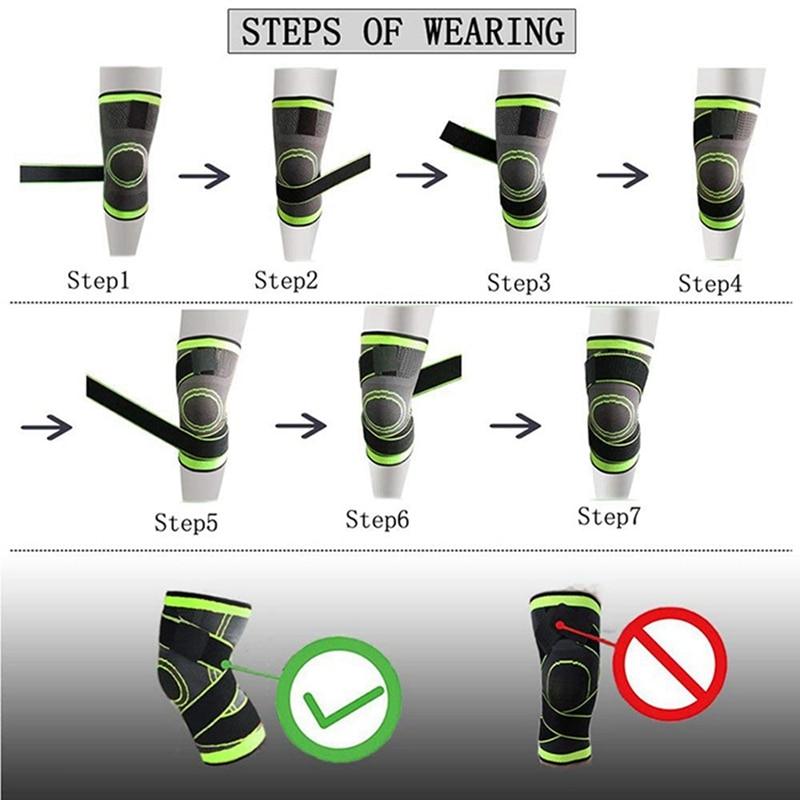
Putting it on
Thirty seconds, and it is worth doing in this order rather than yanking it up from the ankle.
Pull it up
Step into it and draw it up the leg with the straps hanging loose and unfastened.
Line up the ring
Sit the knitted ring squarely over your kneecap. Everything else follows from getting this right.
First strap
Take one strap around the leg, across the front, and press it down onto the patch.
Second strap
Cross the other one the opposite way. Snug, not throttling — if your calf tingles or the skin below goes dusky, it is too tight.
What arrives
Ordering for both knees means ordering two. There is no pair option on this listing.
Living with it
- Wash it by hand, cool, and let it dry flat. Elastic knit and hot machine washes are a short relationship. Do not tumble dry it and do not iron it.
- Fasten the straps to themselves before washing so the hook side does not chew the knit.
- Take it off at night. Compression garments are for waking hours; there is no reason to sleep in one.
- It is thin enough to disappear under loose trousers. Under something slim-cut the straps will read as a ridge — that is honest, not a defect.
Questions worth asking
Will this help my arthritis?
We cannot tell you that it will, and we will not. A sleeve does not act on joint disease. Some people with sore knees like wearing one because it is warm and snug; that is a comfort preference, not a treatment, and your clinician is the right person to ask about the arthritis itself.
Does it have a gel pad or metal side springs?
No. Some photographs floating around this product category show a silicone patella ring or a spiral metal stay — those belong to a different sleeve. This one is knit and straps only.
How many do I get?
One sleeve, for one knee, plus its two straps. Add two to your cart if you want both knees covered.
Left knee or right knee?
Either. It is symmetrical, so the same sleeve fits both — just wrap the straps in whichever direction sits comfortably.
Can I wear it to run or lift in?
People do. It is a comfort and warmth layer, not protective equipment, so it should not change how hard you are willing to load the knee. If the knee only tolerates the activity with the sleeve on, that is information about the knee, not an endorsement of the sleeve.
Will it slide down?
The straps exist largely to stop that. A correctly sized sleeve with both straps fastened stays put for most people through a normal day. One that is too large will migrate no matter how hard you pull the straps — measure first.
How tight should it feel?
Firm and evenly present, never pinching. You should be able to bend the knee fully and feel no throbbing, numbness or tingling below it. If you do, loosen the straps; if that does not fix it, size up.
What is it made of?
An elastic knit with hook-and-loop straps. We do not have a certified fibre breakdown from the manufacturer, so we are not going to print one. If you have a known textile or latex sensitivity, treat that as unconfirmed and take the usual care on first wear.
A simple sleeve, described honestly.
Measure your knee, pick the size the tape gives you, and wear it because it is warm and snug — not because a title promised you something a sleeve cannot deliver.