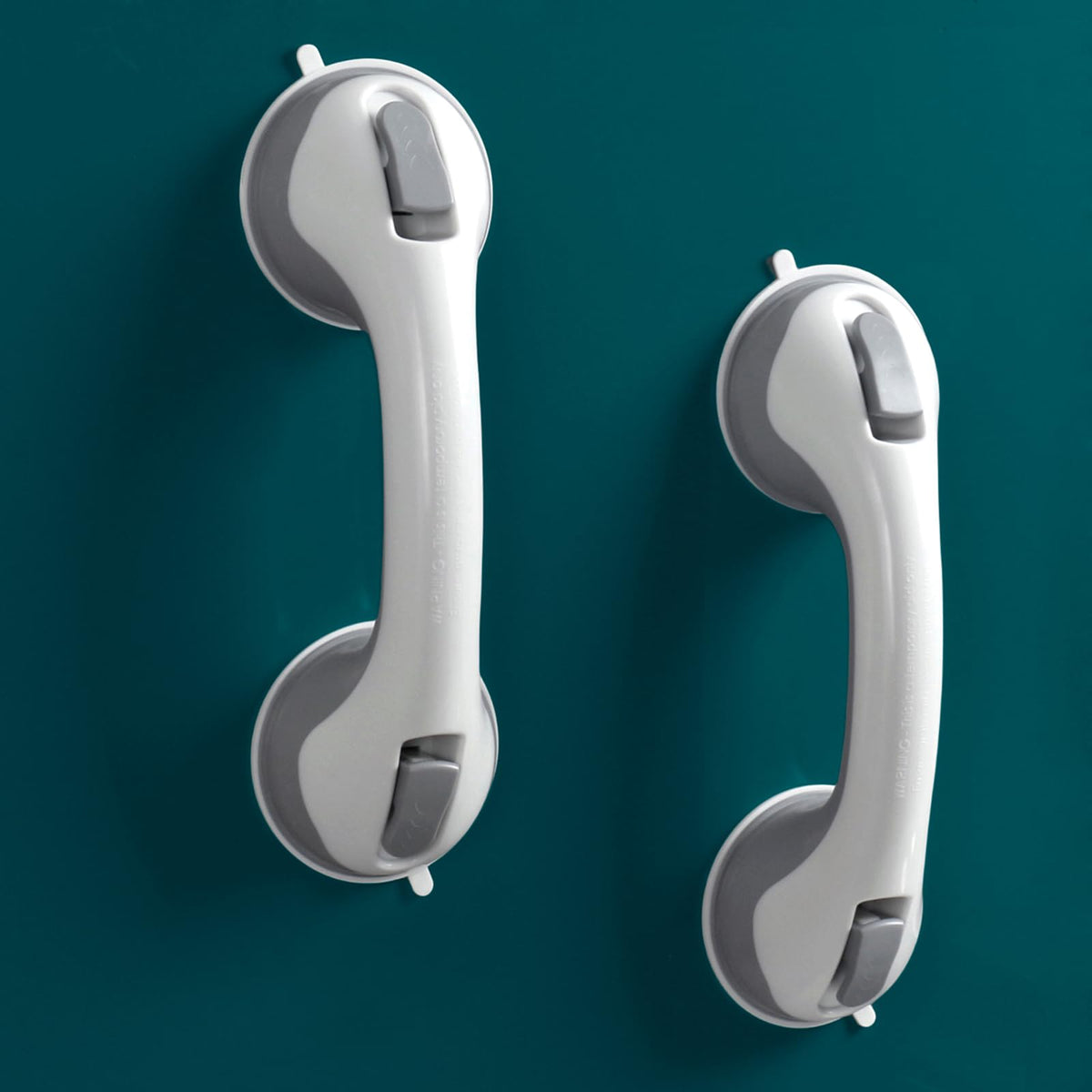
Heavy Duty Suction Shower Grab Bars – 2pcs No-Drill Waterproof Handles for Bathtubs & Showers, Safe Support for Seniors and the Elderly
Heavy Duty Suction Shower Grab Bars – 2pcs No-Drill Waterproof Handles for Bathtubs & Showers, Safe Support for Seniors and the Elderly
Couldn't load pickup availability
A handle to steady yourself, exactly where you need one
A pair of grab handles that fix to a smooth bathroom surface with two locking suction cups, with no drilling, no adhesive and no tools. They go up in under a minute, they come off without leaving a mark, and they give you something solid to put a hand on at the two moments that matter most: stepping over the edge of a tub, and turning around under the water.

Read this first: what this is, and what it is not
This is a steadying handle. It is not a substitute for a drilled grab bar, and it should never be treated as one. A permanently mounted grab bar is bolted through the wall into structural timber, and it is engineered so that it will still be there if someone puts their whole weight on it or falls against it. This handle is held to the wall by air pressure against a smooth surface. Those are two different products doing two different jobs.
Use it the way it is meant to be used: a hand resting on it for balance and reassurance while you are already on your feet. Do not use it to haul yourself up out of the bath, do not lean your body weight into it, and do not fit it anywhere on the assumption that it will catch someone who is falling. If the person using the bathroom genuinely needs a bar that will hold their weight, they need a fixed one bolted into the structure - and it is worth having an occupational therapist look at where it goes.
We would rather sell you fewer of these and have you use them correctly than have one come off a wall. Everything below follows from that.

It only holds on smooth, sealed surfaces - check yours before you order
This is the single most useful thing on this page, and it is the reason most suction handles fail. A suction cup holds by sealing a ring of soft plastic flat against a surface and pushing the air out from underneath. Anything that breaks that ring lets air back in, and once air is getting in the cup is only pretending to hold.
Each cup on this handle is 4 in (10.2 cm) across. That is the number to take to your bathroom wall. Every one of those four cups needs a continuous, smooth, non-porous patch at least that wide, with nothing crossing it.
- It works on glass shower panels, large-format glazed ceramic and porcelain tile, acrylic and fiberglass tub surrounds, and polished sealed stone.
- It does not work on grout lines, small tiles or mosaic, textured or anti-slip surfaces, the molded non-slip floor of a bathtub, unglazed or honed tile, natural porous stone, painted or papered plaster, or any wall with a matte, sandy or hammered finish.
Measure your tiles. If they are smaller than about 4 in, a grout line will run underneath the cup and the handle will not hold properly, no matter how hard you press it on. That is not a fault in the product - it is what suction is.

About the load figure
The supplier prints a 300 lb maximum load on their own marketing material. We are passing that on as their number, and we want to be straight about what it is worth.
No test standard is named behind it. More importantly, a number like that describes the strength of the plastic handle - not the strength of the seal, and the seal is the part that lets go. How much a suction cup will actually hold depends on your surface, how clean and dry it was when you fitted it, the temperature of the room, and how many hours it has been up. None of that is knowable from a figure printed on a box, which is why we will not repeat it as a safety promise.
There is one more thing worth knowing about how suction fails. A cup is at its strongest against a straight pull away from the wall, and at its weakest against a downward or angled pull, because that peels the rim instead of pulling on it. Hanging your weight off the handle, or pulling down and out on it to stand up, is the exact direction it is least able to resist.

There is no indicator window on this model - so check it yourself
Some suction handles have a small red-and-green window that shows you at a glance when the seal has gone. This one does not have that. The only way to know it is still holding is to check it, and the supplier's own instructions say the same thing in their final step.
Make it a habit, every single time, before you put a hand on it:
- Look at both levers. They should still be pressed flat.
- Take hold of the handle and give it a firm tug straight out from the wall.
- If it shifts, creeps, or you hear air, take it off and re-fit it before you use the bathroom.
Suction cups do not fail suddenly and obviously. They creep, quietly, over hours - and a bathroom that heats up for a shower and cools down again overnight is exactly the environment that makes them creep. A handle that was rock solid last night is not automatically solid this morning.
Fitting them
Clean and dry both the wall and the cups first. A film of soap residue is the most common reason a cup will not seal, and it is invisible. Then lift both levers, press the handle squarely against the surface and hold for about five seconds, press both levers down flat, and tug it to check before you trust it. Under a minute per handle, no tools, nothing drilled and nothing glued.
Because nothing is bonded to the wall, they lift off cleanly and can be moved to a different surface or taken with you - which is what makes them worth having in a rented home, a holiday let, or for a temporary need during recovery.

What you get
Older copies of this page listed the size as "3.93 x 16.53 inches". The first of those two figures is not a dimension of the handle at all - it is the diameter of one suction cup. The measurement that actually matters for planning is how far the handle stands off the wall, which is about 3.4 in.

Where to put them
Two handles is genuinely more useful than one, because there are two separate moments where balance goes. Most people end up with one where they step in and out over the edge of the tub or the shower tray, and one on the wall where they stand to wash and turn around.
Mount them at a height that lets the hand rest naturally at roughly hip to waist level with the arm relaxed - not so high that reaching for it pulls the shoulder up, and not so low that it drags the body into a stoop. And put them where the surface is best, not merely where they would be tidiest.