Portable Car Battery Charger - 12 Volt
Portable Car Battery Charger - 12 Volt
Couldn't load pickup availability
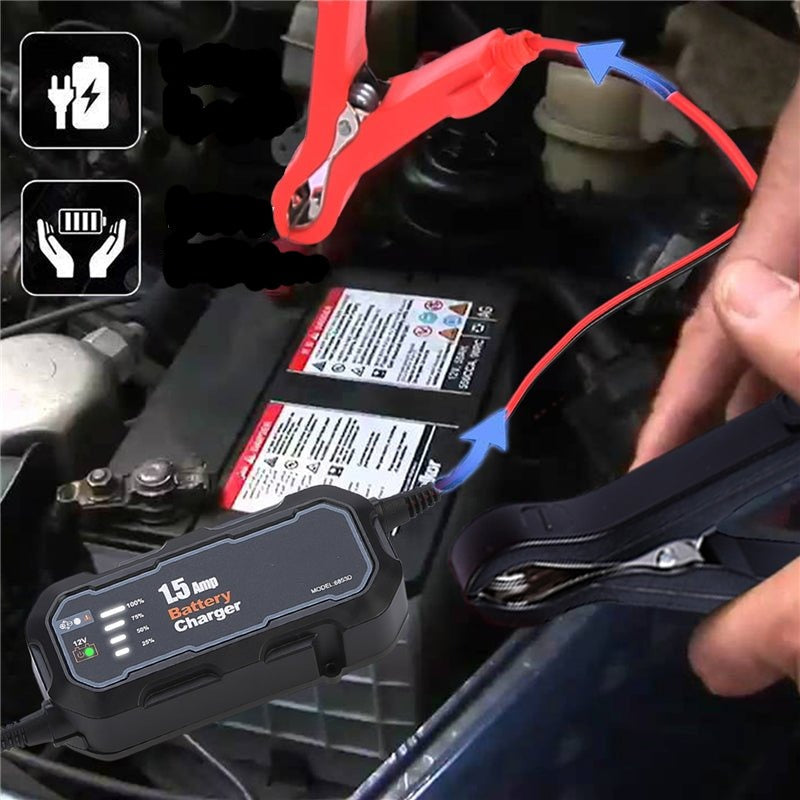
A 1.5 amp charger and maintainer for 12 V lead-acid batteries
This is a small plug-in charger that tops up a 12-volt lead-acid battery slowly and then holds it at full charge for as long as it stays connected. It is the device you clip onto a car, motorcycle, mower or boat that is going to sit for weeks, so the battery is ready when you come back to it. It is not a jump starter, and it will not start a car with a flat battery on the spot; read the section below before you buy.
What it actually does
- Charges at 1.5 amps. The rating label reads 12 V, 1500 mA output. That is a slow, gentle rate meant for topping up and maintaining, not for bringing a large flat battery back in an hour.
- Runs automatically. Clip it on, plug it in, and the microprocessor runs the charge and then drops into a float (maintenance) mode when the battery is full. There is nothing to set and no switch to remember.
- Shows you where it is. Four white LEDs step through 25%, 50%, 75% and 100% as the charge comes up. A green 12 V lamp shows it is running, and a red lamp shows a fault such as a reversed connection.
- Protects itself and the battery. The maker's manual and rating label list reverse-polarity, short-circuit, overload, over-temperature, low-voltage and high-voltage protection. The clamps give no output until they are on a battery, so a stray clamp does not spark.
- Two ways to connect. A clamp lead for occasional use, and a ring-terminal lead you can bolt to the battery posts and leave in place, with an SAE quick-connect so you just plug the charger in each time.
- Small. About 5.9 in long, 2.8 in wide and 1.6 in thick, around 12 oz, with moulded mounting eyes on the back if you want to screw it to a wall or a bulkhead.
What it is not
- Not a jump starter. It has no internal battery and no starting current. A flat battery needs hours on this charger before the engine will turn over; a large, deeply discharged battery can take a day or more (see the chart). If you need to start a car now, you want a jump starter or a booster pack, not this.
- Not a fast charger. At 1.5 A this is the slow end of the range. Buy it to keep a battery topped up, not to rescue one.
- Not for lithium, and not for 6 V. The maker's manual limits it to 12-volt lead-acid batteries: flooded (wet), gel and AGM. Do not use it on lithium batteries or on 6-volt batteries.
- Not weatherproof. The shell is rated IP20, which means indoor, dry use only. Keep it in the garage or under cover, out of rain and away from standing water.
- Not UL or ETL listed. The unit carries CE, FCC and RoHS marks. It does not carry a UL, ETL or other US safety-laboratory listing mark. If your insurer, workplace or local code requires a listed charger, this is not the one to buy.
How long a charge takes
These are the maker's approximate figures for charging a fully discharged battery at 1.5 A. A battery that is only partly down will take proportionally less time. Batteries that are sulfated or very old can take longer, or may not recover.
How to use it
- With the charger unplugged from the wall, fit the lead you want: clamps, or the ring-terminal lead bolted to the battery posts.
- Connect red to the positive (+) post first, then black to the negative (-) post. If the battery is in a vehicle, the maker suggests putting the black clamp on bare chassis metal away from the battery and fuel lines.
- Plug the charger into the wall. The green 12 V lamp comes on and the percentage LEDs start stepping up. If the red lamp lights instead, unplug it and check the polarity.
- Leave it. When the 100% LED holds steady the charger has switched to float mode and can stay connected through a season of storage.
- To disconnect, unplug from the wall first, then remove black, then red.
Charge in a ventilated space and keep the charger away from open flame and sparks: lead-acid batteries give off hydrogen while charging, and the rating label carries an explosive-gas warning for that reason. Do not charge a frozen or damaged battery, and do not run the engine while the charger is connected.
Specification, from the rating label and the maker's manual
Who it suits, and who it does not
- Good for: a second car, a motorcycle over winter, a riding mower or ATV in the off season, a boat or trolling-motor battery between trips, a camper in storage. Anything with a 12 V lead-acid battery that sits.
- Not for: starting a car with a dead battery today, charging a large battery quickly, lithium or 6 V batteries, or outdoor use in the weather.
In the box
- One 1.5 A charger with attached wall lead and SAE quick-connect output
- One clamp lead (red and black insulated clamps)
- One ring-terminal lead with SAE connector
- Instruction sheet
What changed on this page. This page used to describe the charger as something that could start a car in seconds. It cannot; it is a slow charger and maintainer, and we have rewritten the page to say exactly what it does, how long a charge takes, which batteries it is for, and what marks it carries. Every figure above comes from the unit's own rating label or the maker's printed manual.
Share